
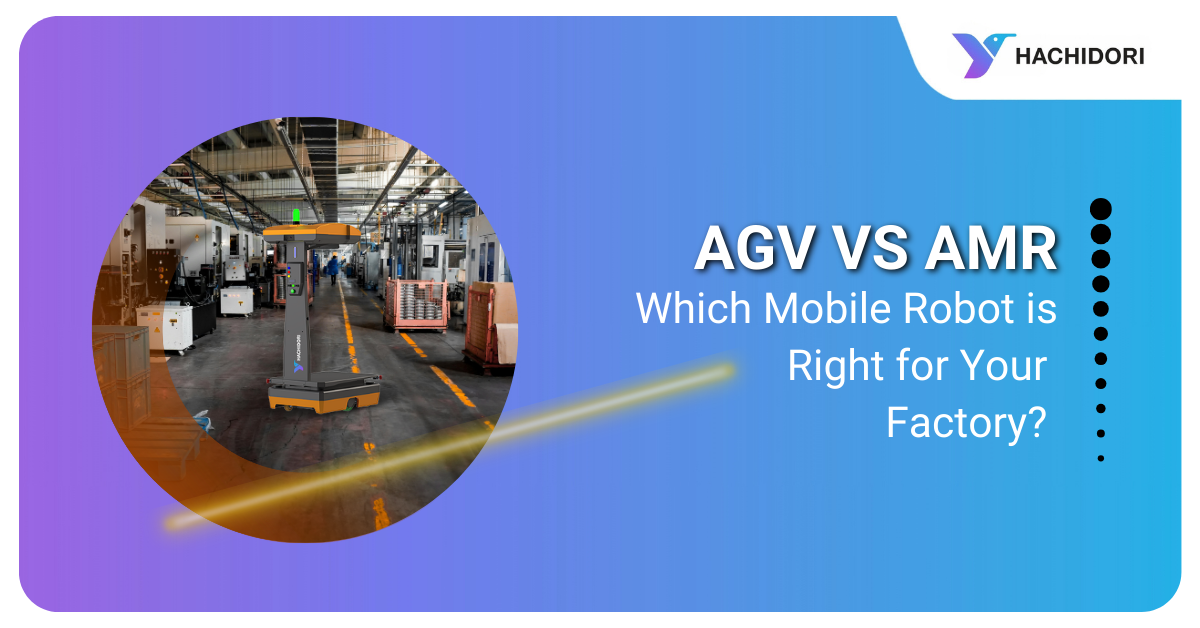
AGV vs AMR is one of the most discussed topics in modern warehouse automation and material handling systems. Understanding the difference between AGV vs AMR helps businesses choose the right robotic solution for improving efficiency, flexibility, and productivity in their operations.
In today’s competitive manufacturing landscape, factory automation is essential for boosting production efficiency and staying ahead. Industry leaders are turning to mobile robots in intralogistics like AGVs (Automated Guided Vehicles) and AMRs (Autonomous Mobile Robots) to address inefficient internal logistics causing production delays . These factory automation robots streamline material movement, reduce downtime, and enhance throughput in sectors like automotive, FMCG, manufacturing, and warehousing. Indian innovator Hachidori Robotics, with its patented wireless natural navigation technology, exemplifies this shift by offering AMRs that handle loads from 50kg to 2T without floor modifications, serving dynamic factory environments.
What Are AGVs (Automated Guided Vehicles)?
AGVs are battery-powered vehicles that transport materials along predefined paths in factories and warehouses. They rely on fixed guidance systems such as magnetic tapes, wires embedded in the floor, QR codes, or laser reflectors to navigate. Common in stable, high-volume settings, AGV excel at repetitive tasks like line feeding in automotive assembly. However, changing routes requires physical infrastructure updates, leading to downtime and costs. Safety features include basic sensors that halt the vehicle upon obstacle detection, but they cannot reroute independently.
AGVs suit warehouse mobile robots applications with unchanging layouts, offering reliable performance where predictability trumps adaptability. Their infrastructure dependency makes them less ideal for smart factory automation with frequent reconfiguration.
What Are AMRs (Autonomous Mobile Robots)?
AMRs represent the next evolution in smart factory automation , navigating independently using onboard sensors like LiDAR, 3D cameras, and SLAM (Simultaneous Localization and Mapping) technology. Unlike AGVs, they create digital maps of environments, detect obstacles in real-time, and dynamically replan routes without fixed paths. Hachidori’s AMRs, for instance, employ patented wireless beacons for precise positioning (<3cm accuracy), enabling in-place rotation and speeds up to 5km/h across loads of 200-2000kg.
These factory automation robots integrate seamlessly with human workflows, slowing or rerouting around workers for enhanced safety per ISO 3691-4 standards. Hachidori’s lineup including Lift & Move (up to 2T), Tugger, and Lightweight models caters to automobile, electronics, pharmaceutical, and FMCG industries, automating intralogistics without infrastructure changes.
AGV vs AMR: Key Differences Explained
The AGV vs AMR comparison reveals stark contrasts in capabilities, making the choice pivotal for AGV vs AMR for factories . Here’s a breakdown:
| Feature | AGV | AMR |
| Navigation | Fixed paths (tapes, wires, QR codes) | Sensor-based, dynamic SLAM (LiDAR, cameras) |
| Flexibility | Low; route changes need infrastructure | High; real-time adaptation to changes |
| Infrastructure Requirements | High (floor modifications) | None; quick deployment |
| Safety | Stops at obstacles; basic sensors | Advanced avoidance, 360° detection |
| Scalability | Limited by paths; costly expansion | Fleet software for easy scaling |
| Deployment Time | Weeks (install guides) | Days (map and go) |
| Cost (Initial vs Long-term) | Lower initial; high maintenance | Higher initial; lower TCO via flexibility |
Difference between AGV and AMR lies in autonomy: AGVs follow rigid lines like trains on tracks, while AMRs navigate like self-driving cars, optimizing mobile robots in intralogistics . Hachidori’s no-infra AMRs exemplify this, reducing setup time and costs for Indian factories.
Which Mobile Robot Is Right for Your Factory?
Choosing between AGV vs AMR for factories depends on operational realities. Evaluate these decision criteria :
- Factory Layout Stability : Fixed layouts favor AGVs; dynamic ones need AMRs.
- Production Volume : High-volume repetition suits AGVs; variable flows benefit from AMR flexibility.
- Budget Constraints : AGVs for capex-limited starts; AMRs for long-term savings via scalability.
- Expansion Plans : AMRs scale via software; AGVs require rework.
- Digital Maturity : Smart factory automation thrives with AMRs’ integration to WMS/ERP.
For which is better AGV or AMR , assess pain points like delays from layout changes, AMRs resolve these faster. Hachidori’s solutions, with 8-hour battery life and bidirectional movement, fit growing Indian manufacturers.
Use Cases: When AGVs Make Sense
AGVs shine in fixed routes and high-volume repetitive tasks :
- Automotive assembly lines moving parts predictably.
- Stable warehouses with unchanging pallet flows.
Their reliability minimizes errors in rigid setups, though inflexibility limits broader factory automation robots adoption.
Use Cases: When AMRs Are the Better Choice
AMRs dominate dynamic layouts , mixed SKU environments , and Industry 4.0 :
- FMCG/pharma with variable orders; Hachidori Tuggers handle bulky items.
- Electronics manufacturing; Lightweight AMR navigate narrow aisles at 1.5m/s.
- Warehousing expansions; Dock & Convey models integrate without downtime.
Warehouse mobile robots like Hachidori’s excel here, boosting throughput 3x via real-time tracking.
Final Verdict: AGV or AMR?
In the AGV vs AMR debate, AMRs emerge superior for most modern factories pursuing smart factory automation . Their flexibility, safety, and low infrastructure needs address inefficient internal logistics causing production delays , offering faster ROI (often <2 years). While AGVs suffice for ultra-stable operations, AMRs future-proof growth.
Future trends in mobile robotics point to AI-enhanced AMRs with multi-modal navigation, deeper WMS integration, and cobot arms, Hachidori leads with 3 Indian patents. Factory owners: audit your layout and volumes; opt for AMRs like Hachidori’s for agility in India’s booming manufacturing sector. Requset demo for your factories automations.