
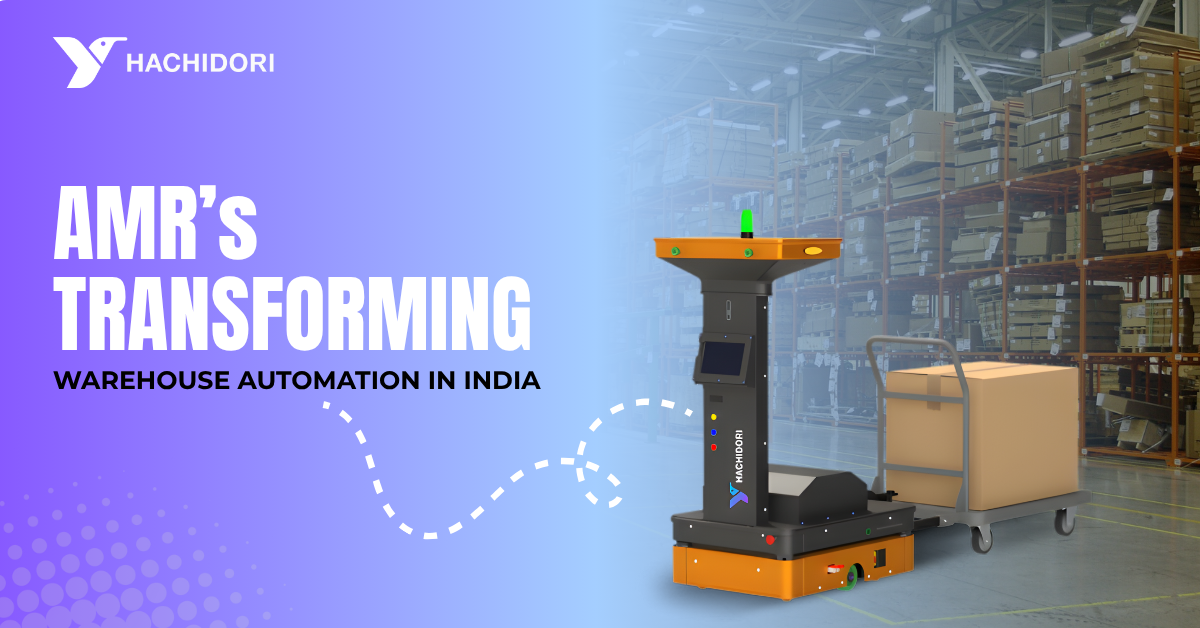
Manufacturing and warehousing industries in India are undergoing a fundamental transformation with the rapid adoption of autonomous mobile robots (AMRs). As operational costs surge and labor shortages persist, companies across sectors are exploring new ways to enhance productivity and efficiency.
Leading the AMR revolution in India, Hachidori Robotics, a Bangalore-based AMR engineering leader , provides world-class automated mobile robots designed and built right here in India for Indian industries.
What are AMRs?
Autonomous mobile robots (AMRs) are smart machines that can autonomously transport materials and goods within factories, warehouses, or distribution centers. Unlike fixed-path Automated Guided Vehicles (AGVs), AMRs use advanced sensors, patented indoor positioning systems, and navigation algorithms to dynamically navigate complex and changing environments. Hachidori Robotics’ AMRs are 100% Made in India, feature a customizable chassis, and are suitable for various industry applications.
AMRs key features:
- Patented indoor GPS navigation enables movement at the pallet/box level with sub-meter accuracy, allowing safe operation in changing factory/warehouse layouts with temporary obstacles.
- Load capacities range from 200 kg to 1.5 tons to cater to automotive, FMCG, manufacturing, warehousing, and other industry-specific needs.
- Plug-and-play solution for easy integration with existing workflows, warehouse management systems (WMS), and automated storage & retrieval systems (ASRS).
- Integrated data analytics for real-time visibility of material movement to identify and address production bottlenecks.
Top Benefits for Indian Warehouses
Automation of material movement using AMRs addresses several prevalent pain points for Indian warehouses:
1. Productivity
Manual movement of material within the production floor or warehouses is slow, labor-intensive, and often associated with delays and errors. The Hachidori AMR automates end-to-end production line & warehouse operations to move raw materials, work in progress (WIP), finished goods, and expedite order fulfillment processes. They offer faster movement of carts/pallets/bins, reduced downtime, and higher throughput for picking lines/orders, warehouses, and micro-fulfillment centers.
2.Labor Cost
Labor shortages, high attrition, and increasing wages make it difficult to rely on manual labor. The AMRs help automate material movement, thereby reducing human intervention and operational delays. Automated movement also minimizes fatigue, increasing productivity. Companies can redeploy human resources to focus on higher-value tasks that require human skills.
3. Efficiency & Reliability
Precise and reliable movement is made possible by Hachidori’s patented navigation technology which features real-time pinpoint positioning and accurate obstacle detection & avoidance. The AMRs can be customized to follow variable speeds, set speed limits in specific areas, integrated with factory safety systems, and be recalled “on call” to specific areas in the facility in a reliable and repeatable manner.
4. Hygienic and Safe Operations
AMRs also reduce movement of humans in the production zone, improving the hygienic conditions in food & beverage, pharma, and electronics manufacturing. Automated material movement is much safer and less prone to contamination and workplace accidents.
5.Scalable and Customized Solutions
Hachidori’s AMRs come in different variants – pallet movers, tuggers, on-top load carriers and can be customized for specific industry needs. They are easy to deploy and require no additional investment in physical infrastructure like magnetic strips or QR codes.
Real Examples in Indian Warehouses
Hachidori has successfully deployed AMRs in several industry verticals.
- Automotive: AMRs move heavy automotive components and finished vehicles within the assembly plant, reducing manual handling and improving line efficiency.
- FMCG: AMRs in FMCG warehouses move bulk pallets for order picking and replenishment tasks, enabling the warehouse to respond to fast-changing market demands.
- Manufacturing: Textile, garment, plastic, electronic goods, pharmaceutical and other manufacturing units have deployed AMRs for automated movement of WIP material, as well as integrate them with their ASRS to get real-time tracking of production bottlenecks and material flow.
- Warehousing: AMRs are being used in cold storage operations, pallet movement, and integrated with WMS in large-scale warehousing and distribution centers.
Case Study: Food & Beverage Industry
Hachidori’s AMR with built-in lifting solutions (lift capacity up to 1.5 tons) has been used by the F&B warehouses to move perishable as well as non-perishable consumables inside warehouses. Their Dock and Convey AMR model complements automated storage and retrieval systems for seamless transfer of raw material and outbound order fulfillment.
ROI Stats and Facts
Investing in AMRs in India provides quantifiable value to manufacturers and warehouse operators. Return on investment (ROI) includes:
- Cost Savings: Labor cost reduction, error reduction, and lower operational expenses.
- Productivity Gains: Faster turnaround times, increased order accuracy, and better resource utilization.
- Scalability & Flexibility: Hachidori’s plug-and-play modular solution can be easily scaled up as business demand grows without additional infrastructure cost.
- Competitive Advantage: Early movers get a strategic advantage in efficiency, reliability, and customer satisfaction.
Key Data points and Hachidori Robotics
- 3 Patents on indoor positioning and navigation technologies. Unique in the Indian market, ensuring customized solution capabilities.
- Load capacities ranging from 200 kg to 1.5 tons to cover the requirements of the Automotive, FMCG, manufacturing, warehousing, and other verticals.
- Offices in Karnataka, Maharashtra, Delhi, and Tamil Nadu with expansions in progress for Pune
- Customizable and adaptable solutions for Automotive, FMCG, Manufacturing, Warehousing and other industries.
Challenges in Adoption
Indian manufacturers and warehouse operators considering AMR technology face a few challenges:
- Initial Investment: Investment and costs to deploy AMRs are perceived to be high, especially for small and medium businesses.
- Change Management: Transition to AMRs involves change management – training human resources and reengineering processes for the human-machine hybrid operations.
- Integration Complexity: Integrating AMRs with existing WMS, ERP, and safety protocols can be challenging.
Future Trends
- Outdoor Navigation: Hachidori Robotics is developing AMRs with outdoor GPS navigation to expand the application of AMRs beyond indoor environments.
- AI and IIoT: Hachidori’s AMRs will be integrated with Artificial Intelligence (AI) and the Industrial Internet of Things (IIoT) for advanced data analytics, predictive maintenance, and intelligent decision-making.
- Wider Adoption: As AMR technology awareness increases and costs come down, AMRs will become a mainstream automation choice for Indian warehouses and factories.
Conclusion
Autonomous mobile robots India is revolutionizing the way warehouses are operated and managed. AMRs offer practical value in the form of increased productivity, cost savings, and operational efficiency for Indian companies.
Hachidori Robotics is a leading provider of patented, customizable, and Made in India AMR solutions for Indian industries. Warehouse operators, supply chain managers, and logistics technology buyers should seriously consider adopting AMRs as a strategic step towards their smart warehouse vision in India.
Visit Hachidori Robotics to know more about the AMR solutions for your warehouse.