
Introduction
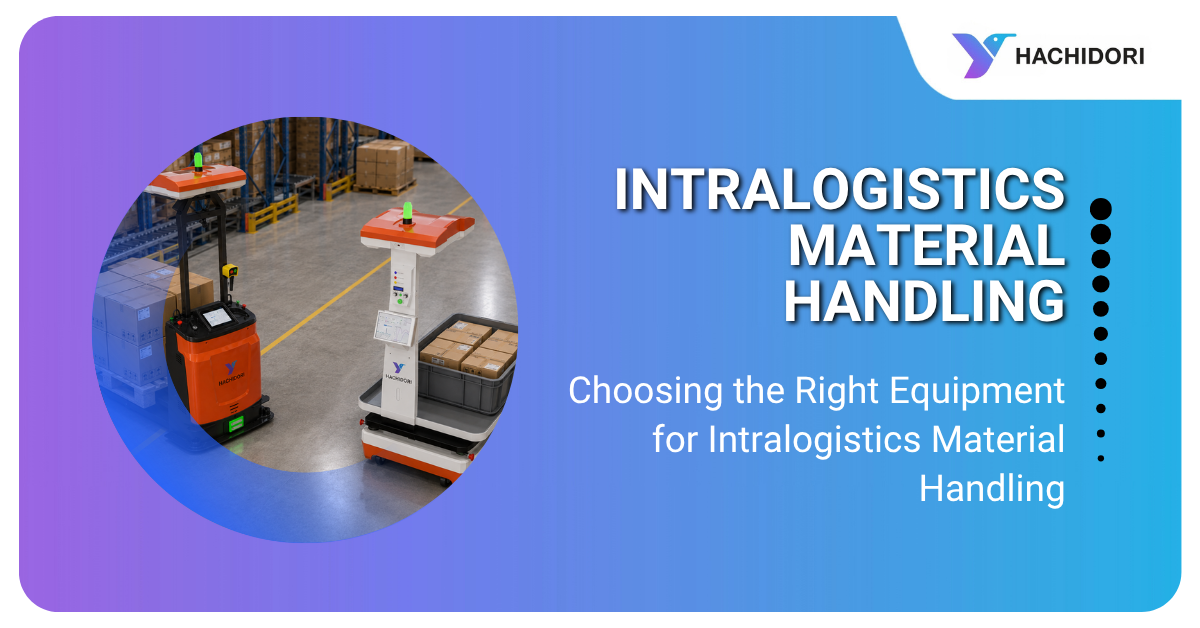
Intralogistics material handling equipment is the backbone of efficient factory and warehouse operations, helping businesses move goods faster, safer, and more reliably across their shop floors and storage areas. By choosing the right mix of equipment from basic pallet jacks to advanced Automated Mobile Robots (AMRs), industries can reduce manual handling inefficiencies, cut downtime, and unlock higher productivity.
What Is Intralogistics Material Handling?
Intralogistics material handling refers to all internal movements of goods and materials within a facility such as factories, warehouses, fulfillment centers, and distribution hubs. It covers activities like:
- Receiving and unloading incoming materials
- Moving pallets and totes to storage
- Feeding production lines with components
- Replenishing pick faces and dispatch zones
- Transporting finished goods to staging or shipping
When intralogistics material handling is poorly designed, operations suffer from slow material transportation, congestion, inventory delays, and worker safety risks . On the other hand, a well-planned intralogistics system, supported by the right equipment, turns material flow into a competitive advantage.
Modern companies like Hachidori Robotics focus specifically on automating material movements in industrial manufacturing, warehousing, logistics, FMCG, electronics, and pharmaceuticals using intelligent AMRs and patented indoor positioning technologies. Their goal aligns with the core outcome of intralogistics: fast, efficient, reliable movement of goods that supports lean, high-performing operations.
Why Material Handling Equipment Is Important?
Material handling equipment is not just hardware, it is a strategic enabler of better business outcomes. For warehouse managers, logistics heads, and factory operations teams, choosing the right equipment impacts:
- Throughput: How quickly goods can move from receiving to shipping
- Labor efficiency: How much manual effort is required for routine movements
- Safety: Exposure to lifting, pulling, and collision risks for workers
- Space utilization: How well aisles, docks, and storage zones are used
- Operational continuity: Reduction in bottlenecks and unplanned stoppages
The wrong equipment or a reliance on purely manual processes often leads to:
- Slow material transportation
- Manual handling inefficiencies
- Warehouse congestion and blocked aisles
- Operational downtime when equipment fails or labor is unavailable
- High dependency on skilled forklift drivers
- Inventory movement delays that affect production schedules
- Worker safety risks, especially around heavy loads and mixed traffic
Upgrading to modern intralogistics material handling equipment directly addresses these pain points. With equipment such as conveyors, pallet handling systems, AMRs, AGVs, and ergonomic lifters , companies can design flow-based operations rather than ad-hoc, person-dependent processes.
Types of Intralogistics Equipment
In a typical factory or warehouse, a combination of traditional warehouse material handling equipment and advanced intralogistics solutions works together to keep goods moving. Below are the core categories, their applications, and business benefits.
1.Pallet Jacks and Hand Trucks
What they are:
Basic manual tools used for short-distance movement of pallets or cartons within small warehouse zones or shop floors.
Applications:
- Moving pallets from dock to nearby staging areas
- Rearranging goods in low-volume storage zones
- Handling light loads in tight spaces where larger equipment cannot enter
Business value:
- Low cost and minimal maintenance
- Good for occasional or low-frequency movements
- Simple to train and deploy
Limitations:
For high-volume operations, pallet jacks quickly become a bottleneck. They increase labor dependency , slow down throughput, and provide minimal safety features compared to modern warehouse automation equipment.
2.Forklifts and Reach Trucks
What they are:
Powered lift trucks designed to handle heavy pallets, stack loads vertically, and work in racking systems.
Applications:
- Loading and unloading trucks at docks
- Storing and retrieving pallets from racks
- Moving heavy materials across the warehouse
Business value:
- High lifting capacity and versatility
- Essential for pallet handling systems in traditional warehouses
Limitations and risks:
- Require licensed, trained operators
- Higher risk of accidents in congested aisles
- Subject to downtime if operators are unavailable or equipment is under maintenance
- Not ideal for repetitive, predictable routes where automation can perform better
For many facilities, forklifts are now complemented or partially replaced by conveyor systems and AMR-based pallet handling systems to reduce traffic and safety risks.
3.Conveyor Systems and Dock Equipment
What they are:
Fixed warehouse material handling equipment designed to provide continuous, automated movement of goods along predefined paths especially for cartons, totes, and pallets.
Applications:
- Moving goods from receiving to sortation or storage
- Connecting production lines to packing or dispatch zones
- Automating loading/unloading activities at docks
Business value:
- High throughput, predictable flow, and reduced manual handling
- Lower risk of congestion when designed correctly
- Ideal for repetitive, high-volume operations
Limitations:
- Require upfront infrastructure and layout changes
- Inflexible once installed adjustments for new products or routes may be costly
Modern solutions, such as Jumbo Dock & Conveyor systems used with AMRs, combine conveyors with mobile robots to offer both continuous flow and layout flexibility .
4.Automated Guided Vehicles (AGVs)
What they are:
AGVs are mobile vehicles that follow fixed paths often guided by magnetic strips, reflectors, or markers to move materials autonomously.
Applications:
- Line feeding in manufacturing plants
- Pallet transfers between warehouses and production areas
- Tugger operations pulling multiple carts
Business value:
- Reduce reliance on forklift drivers
- Provide repeatable, predictable routes suitable for industrial material movement
- Improve safety by operating at controlled speeds with defined paths
Limitations:
- Path changes require physical modifications (strips, markers)
- Less flexible for dynamic layouts or frequently changing workflows
AGVs are effective for stable environments. However, industries with dynamic operations are increasingly adopting AMRs as a more flexible intralogistics solution.
5.Autonomous Mobile Robots (AMRs)
What they are:
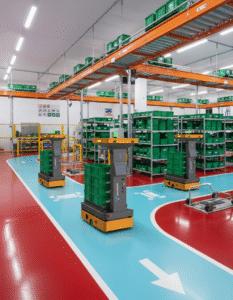
AMRs are intelligent, self-navigating robotic platforms that move goods through facilities using advanced indoor positioning, navigation, and safety sensors instead of fixed paths. Companies like Hachidori Robotics build India’s best Autonomous Mobile Robots for material movement , backed by three patents for indoor positioning and navigation .
Applications:
- Line-side material delivery in automobile and electronics manufacturing
- Intralogistics movements in FMCG and pharmaceutical warehouses
- Pallet, tote, or rack movement between storage, picking, and shipping zones
- Feeding assembly lines and handling returns or replenishments
Business value:
- Fast, efficient, and reliable material movement
- Dynamic routing, robots choose optimal paths based on congestion and priorities
- Seamless integration with warehouse management systems (WMS) and manufacturing execution systems (MES)
- Reduced labor dependency for repetitive intralogistics tasks
- Enhanced worker safety through obstacle detection and controlled speeds
Hachidori’s AMR portfolio includes lightweight AMRs, tuggers, lifters, and Unit Load Carrier (ULC) that can work with different load types such as pallets, racks, and trolleys. This allows industries to tailor intrilogistics solutions to specific use cases in:
- Manufacturing
- Warehousing and storage
- Electronics assembly lines
- FMCG and food processing plants
- Pharmaceutical distribution centers
By automating internal flows, AMRs directly solve the pain points of slow material transportation, congestion, operational downtime, and inventory movement delays , while creating safer, more predictable workflows.
6.Ergonomic Lifters and Specialized Attachments
What they are:
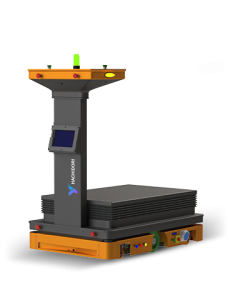
Equipment such as Appu lifters, Jumbo lifters, and APJ lifters are designed to lift, position, or transfer loads ergonomically, often mounted on AMRs or used as standalone tools.
Applications:
- Handling heavy or awkward loads without manual lifting
- Precisely placing materials on machines or racks
- Integrating lifting capability with mobile robots for end-to-end movement
Business value:
- Significant reduction in worker strain and musculoskeletal injuries
- Faster loading/unloading cycles at production lines or workstations
- Improved accuracy in placement and reduced product damage
Combined with intralogistics automation, these lifters transform material handling from a manual, high-risk activity into a controlled, engineered process.
Role of Automation in Material Handling
Automation is transforming intralogistics from labor-intensive tasks to data-driven, robot-enabled flows . In the context of warehouse material handling equipment and industrial material movement , automation delivers:
- Continuous material flow: AMRs and conveyors work together to ensure that materials are available exactly where and when needed.
- Real-time visibility: Automated systems can integrate with WMS/MES to provide live updates on location, status, and throughput.
- Reduced human error: Automated routes and task execution minimize picking, staging, and routing mistakes.
- Scalable capacity: Adding more robots increases capacity without major layout disruptions or long onboarding times.
For industries served by Hachidori Robotics – automobile, FMCG, electronics manufacturing, warehousing, and pharmaceuticals automation helps tackle:
- Complex multi-shift operations
- High SKUs and frequent changeovers
- Tight safety and compliance requirements
- Growing expectations for faster order fulfillment
Automation-driven intralogistics solutions make warehouses and factories more resilient in the face of labor shortages and demand spikes.
Benefits of Modern Material Handling Equipment
Upgrading from traditional, manual systems to modern warehouse automation equipment and intralogistics material handling equipment unlocks several strategic benefits:
- Higher throughput and speed: Goods move faster from dock to rack, from rack to line, and from line to dispatch.
- Lower operational downtime: Automated systems maintain consistent performance across shifts, reducing human-related stoppages.
- Reduced labor dependency: Repetitive transport tasks are offloaded to AMRs and conveyors, allowing staff to focus on value-added activities like quality checks and exception handling.
- Improved safety: Fewer manual lifts and forklift trips lower accident rates and near-miss incidents.
- Better space utilization: Structured flow paths reduce congestion, improve aisle discipline, and free up space for storage or additional lines.
- Scalable operations: As volumes grow, capacity can be scaled by adding robots or optimizing routes, rather than continuously hiring and training new operators.
Ultimately, modern intralogistics equipment becomes a profit enabler rather than a cost center. It supports lean principles, continuous improvement, and long-term competitiveness in demanding industries.
Choosing the Right Equipment for Your Warehouse
Selecting the right intralogistics material handling equipment is a strategic decision that should align with your current pain points and future growth plans. Warehouse managers, logistics leaders, and factory operations teams can follow a structured approach:
- Identify key pain points:
Assess where your operation is constrained dock congestion, slow pallet movement, delayed line feeding, manual handling injuries, or inventory visibility issues. - Map material flows:
Document how materials move today from receiving to storage, to production and dispatch. Note volumes, frequency, SKU mix, and route complexity. - Segment equipment needs:
Decide which zones need traditional warehouse material handling equipment (e.g., forklifts, pallet jacks) and which flows can benefit from automated intralogistics solutions (e.g., AMRs, AGVs, conveyors). - Evaluate automation readiness:
Consider digital maturity (WMS/MES integration), layout stability, and safety policies. Facilities with predictable flows and clear safety norms are ideal candidates for AMRs and AGVs. - Partner with specialists:
Work with experienced solution providers like Hachidori Robotics , who combine patented indoor positioning and navigation with industry-specific expertise across manufacturing, warehousing, FMCG, electronics, and pharma. They can assess your needs, design tailored warehouse automation equipment deployments, and implement scalable intralogistics solutions. - Pilot, then scale:
Start with a focused pilot for example, automating line feeding or dock-to-storage movements with AMRs and measure improvements in speed, safety, and labor utilization. Use these insights to expand automation across the facility.
By approaching equipment selection through a business and operational lens , organizations avoid the risk of choosing the wrong equipment and instead invest in solutions that deliver measurable ROI.
For warehouses, factories, and logistics hubs looking to stay ahead, intralogistics material handling equipment is no longer optional, it is a critical lever for productivity, resilience, and competitiveness. From pallet jacks and forklifts to conveyors, AGVs, and advanced AMRs, each equipment type plays a specific role in shaping material flow. The key is to design an integrated system, backed by reliable automation partners, that turns internal movements into a strategic strength rather than a daily challenge.