
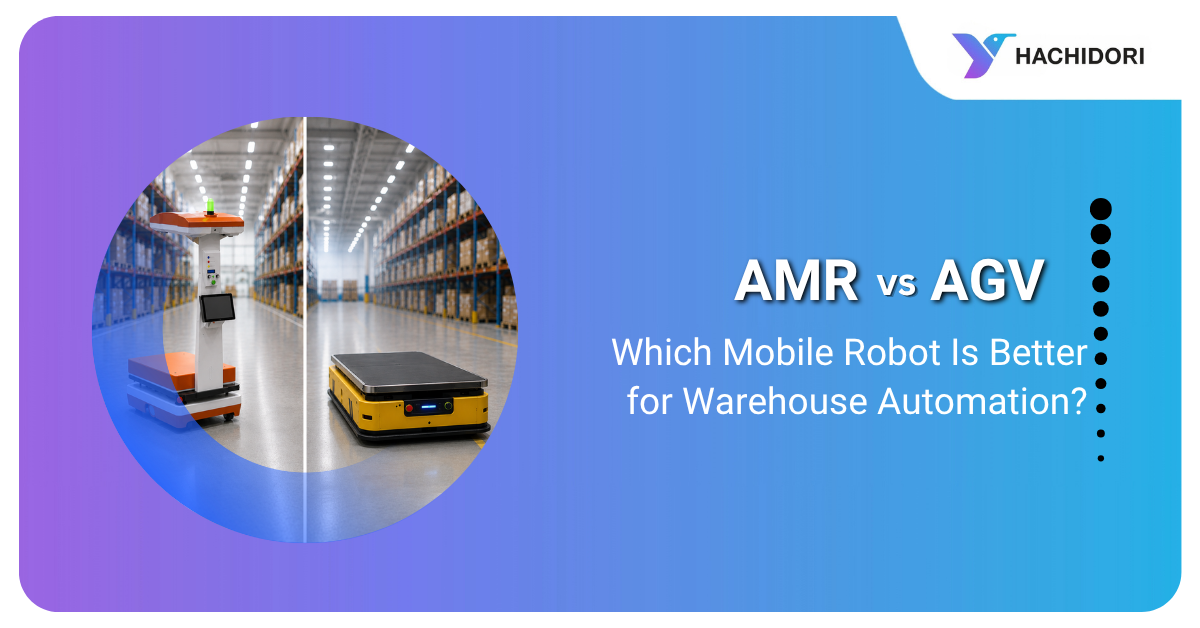
Automating material movement has become a strategic priority for modern factories and warehouses. As order volumes rise, SKUs diversify, and customer expectations tighten, manual material handling and pallet movements quickly become a bottleneck. At this point, many decision-makers evaluate AMR vs AGV options to modernize their intralogistics and warehouse automation solutions.
Autonomous Mobile Robots (AMRs) and Automated Guided Vehicles (AGVs) both move goods from point A to point B inside warehouses and factories. However, they differ significantly in how they navigate, how flexible they are, and how easily they scale as operations grow. Choosing the right technology has a direct impact on productivity, safety, and long-term return on automation.
In this blog, we will break down AMR vs AGV , explain how each technology works, and help you understand which mobile robot is better suited for your warehouse automation journey.
What Are AMRs?
Autonomous Mobile Robots (AMRs) are intelligent, self-navigating mobile robots designed to transport materials within factories, warehouses, and logistics centers. Unlike traditional guided systems, AMRs use onboard sensors, cameras, and software to understand their environment and move independently.
In practical terms, AMRs act like smart “autonomous trolleys” or “self-driving pallet movers” that can:
- Pick up loads from receiving docks
- Deliver materials to storage racks, assembly lines, or packing stations
- Navigate around people, forklifts, and obstacles in real time
Modern AMRs, like those developed by Hachidori Robotics , are engineered specifically for industrial material movement . They focus on automating repetitive, non-value-adding transport tasks across industries such as automotive, FMCG, electronics manufacturing, warehousing, and pharmaceuticals. By leveraging advanced indoor positioning and patented navigation technologies, these robots can operate safely and efficiently in dynamic environments.
Key characteristics of AMRs include:
- Dynamic navigation : They build and update maps of the facility and take optimal paths based on live conditions.
- High flexibility : Layout changes, new routes, or process modifications can be handled through software updates instead of physical infrastructure changes.
- Scalable deployment : Adding more robots to handle higher throughput is relatively straightforward through fleet management software.
For warehouses dealing with frequent SKU changes, reconfigurable racking, and evolving workflows, AMRs provide the agility required to keep intralogistics efficient and future-ready.
What Are AGVs?
Automated Guided Vehicles (AGVs) are mobile robots that follow predefined paths inside a facility. Traditionally, AGVs rely on fixed guidance systems such as magnetic tapes, QR codes, floor tracks, reflective markers, or embedded wires to navigate.
AGVs were the earliest form of warehouse robotics for material movement and are still widely used in highly standardized, predictable environments where material flow rarely changes.
Typical AGV applications include:
- Repetitive pallet transportation between fixed zones (for example, from a conveyor line to a storage lane)
- Long, straight-line movements in large plants where human driving is inefficient
- Closed-loop routes in high-volume, stable production lines
Key characteristics of AGVs include:
- Fixed navigation : They follow pre-defined routes and cannot easily deviate from them.
- Infrastructure dependency : Implementation requires physical guidance infrastructure and significant layout planning.
- Less responsive to change : Any change in route or workflow usually involves physical reconfiguration and downtime.
AGVs can be highly effective for predictable and fixed material movement routes , but they are less suited to dynamic, constantly evolving warehouse environments.
How Do AMRs and AGVs Work?
To understand AMR vs AGV , it’s helpful to look at how they navigate and operate.
AMR navigation typically relies on:
- Onboard sensors such as LiDAR, 3D cameras, and proximity sensors
- Software-based mapping and localization techniques
- Wireless connectivity to a central fleet management system
- Advanced algorithms that let them detect obstacles, recalculate paths, and choose the best routes
In the case of Hachidori Robotics, the company’s AMRs are powered by patented indoor positioning and navigation technologies that enable wireless natural navigation , allowing robots to move without dependence on tracks or markers while maintaining high precision and safety.
AGV navigation , on the other hand, generally relies on:
- Floor-based guidance such as magnetic strips, tapes, or tracks
- Pre-programmed paths defined during implementation
- Limited obstacle handling (often stopping when blocked, instead of rerouting)
As a result, AMRs behave more like “autonomous drivers” that understand the environment, while AGVs behave more like “train cars” that must follow a pre-laid track.
AMR vs AGV: Key Differences
The following table summarizes the main differences between AMRs and AGVs in a warehouse context.
| Aspect | AMRs (Autonomous Mobile Robots) | AGVs (Automated Guided Vehicles) |
| Navigation | Dynamic, map-based, sensor-driven navigation | Fixed routes with tapes, tracks, or markers |
| Flexibility | Highly flexible, supports frequent layout and workflow changes | Low flexibility, changes require physical rework |
| Environment | Designed for dynamic environments with people, forklifts, and obstacles | Best suited for controlled, predictable environments |
| Infrastructure requirements | Minimal physical infrastructure; relies on software and wireless networks | Significant infrastructure (tracks, markers, floor modifications) |
| Implementation time | Typically faster to deploy and configure | Longer planning and installation cycles |
| Scalability | Robots can be added incrementally as demand grows | Scaling often requires new routes and infrastructure changes |
| Obstacle handling | Detects, avoids, and reroutes around obstacles | Mostly stops or waits when blocked |
| Ideal use cases | Variable routes, multi-zone workflows, dynamic intralogistics | Repetitive, fixed transport between known points |
| Long-term adaptability | High – supports continuous improvement and process evolution | Limited – optimized mainly for stable processes |
AMR vs AGV for Warehouse Applications
When evaluating mobile robots for warehouses , it’s important to consider real-world intralogistics scenarios rather than just technology labels. Here’s how AMR vs AGV compares across common warehouse workflows.
- Receiving to Storage
In warehouses where inbound pallets or totes must move from receiving docks to various storage locations:
- AMRs can dynamically assign routes based on storage availability, priority, and congestion. They can handle multiple storage zones and changing layouts without physical modifications.
- AGVs perform well when the route from dock to storage is fixed and rarely changes. However, introducing new storage zones usually requires additional guidance infrastructure.
- Picking and Putaway
For order picking, replenishment, and putaway:
- AMRs can assist pickers by following them, shuttling picked items to packing stations, or moving between shelves based on real-time order priorities. They integrate seamlessly with Warehouse Management Systems (WMS) and can adapt to slotting changes or new SKUs.
- AGVs are suited for structured batch movement, such as transporting full pallets from high-bay storage to a picking area, but are less flexible when routes or destinations change frequently.
- Line Feeding and Production Support
In manufacturing and assembly environments:
- AMRs can supply assembly lines with components just in time, dynamically adjusting routes and schedules based on production plans. This is especially useful in automotive, FMCG, electronics, and pharmaceutical manufacturing where line configurations evolve over time.
- AGVs work well when production lines are fixed and material flow is stable,for example, moving pallets along a single, repetitive loop.
- Inter-zone Transfers and Cross-docking
For cross-docking and inter-zone transfers where goods move between multiple process areas:
- AMRs excel because they can manage multiple route combinations, handle priority-based tasks, and reroute around bottlenecks.
- AGVs can be used, but the number of predefined routes grows quickly, making the system complex and harder to adapt.
In summary, AMRs are generally better suited for dynamic, multi-zone, and evolving warehouse automation , whereas AGVs excel in consistent, highly structured flows with minimal variation .
Advantages and Limitations of AMRs and AGVs
To make an informed decision on AMR vs AGV , you should weigh both their strengths and constraints.
Advantages of AMRs:
- High flexibility : Easily reconfigurable routes and workflows enable warehouses to respond quickly to business changes.
- Reduced infrastructure cost : Minimal or no floor modifications compared to AGVs, making deployment faster and less disruptive.
- Better obstacle handling : Advanced perception and navigation allow AMRs to safely share space with humans, forklifts, and other equipment.
- Scalable automation : Fleets can grow over time without redesigning the entire system, ideal for phased automation strategies.
- Future-ready intralogistics : As demand patterns change, AMRs can be reprogrammed to support new processes, zones, or product lines.
Limitations of AMRs:
- Higher software complexity : Requires robust fleet management, mapping, and integration with WMS/ERP systems.
- Network dependence : Reliable wireless connectivity and IT infrastructure are essential to maintain performance.
- Initial learning curve : Teams need proper onboarding and training to fully leverage the flexibility of AMRs.
Advantages of AGVs
- High repeatability : Excellent for repetitive routes where tasks rarely change, ensuring consistent cycle times.
- Predictable behavior : Following fixed paths can simplify safety zoning and operational planning in some environments.
- Mature technology : AGVs have been used for decades in industrial settings, making their behavior and maintenance well understood.
Limitations of AGVs
- Low flexibility : Any layout change, route variation, or new workflow often requires physical reconfiguration.
- Infrastructure-heavy : Installing tracks, tapes, or guidance markers adds cost and downtime.
- Limited adaptability : In dynamic warehouses with frequent process changes, AGVs can quickly become a constraint rather than an enabler.
Which Mobile Robot Is Better for Your Warehouse?
The question “AMR vs AGV: Which mobile robot is better for warehouse automation?” does not have a one-size-fits-all answer. Instead, the right choice depends on your layout, workflow, and medium- to long-term automation strategy.
AMRs are generally a better fit if:
- Your warehouse layout changes periodically or you anticipate future expansion.
- You handle a wide variety of SKUs and multi-zone flows.
- You want to automate repetitive transport without committing to heavy floor infrastructure.
- You need robots to safely navigate around humans and other vehicles in shared spaces.
AGVs might be the right choice if:
- Your material movement routes are fixed and predictable.
- You operate a highly standardized production line with minimal variation in flows.
- You are comfortable investing in physical guidance infrastructure and prefer tightly controlled pathways.
For many modern warehouses,especially those serving automotive, FMCG, electronics, and pharmaceutical industries,AMRs provide more long-term value by aligning with continuous improvement, lean intralogistics, and agile operations.
How to Choose the Right Warehouse Robot?
To decide between AMR vs AGV , it helps to approach the decision systematically. Consider the followin