
Introduction
Intralogistics material handling equipment is the backbone of efficient factory and warehouse operations, helping businesses move goods faster, safer, and more reliably across their shop floors and storage areas. By choosing the right mix of equipment from basic pallet jacks to advanced Automated Mobile Robots (AMRs), industries can reduce manual handling inefficiencies, cut downtime, and unlock higher productivity.
What Is Intralogistics Material Handling?
Intralogistics material handling refers to all internal movements of goods and materials within a facility such as factories, warehouses, fulfillment centers, and distribution hubs. It covers activities like:
- Receiving and unloading incoming materials
- Moving pallets and totes to storage
- Feeding production lines with components
- Replenishing pick faces and dispatch zones
- Transporting finished goods to staging or shipping
When intralogistics material handling is poorly designed, operations suffer from slow material transportation, congestion, inventory delays, and worker safety risks . On the other hand, a well-planned intralogistics system, supported by the right equipment, turns material flow into a competitive advantage.
Modern companies like Hachidori Robotics focus specifically on automating material movements in industrial manufacturing, warehousing, logistics, FMCG, electronics, and pharmaceuticals using intelligent AMRs and patented indoor positioning technologies. Their goal aligns with the core outcome of intralogistics: fast, efficient, reliable movement of goods that supports lean, high-performing operations.
Why Material Handling Equipment Is Important?
Material handling equipment is not just hardware, it is a strategic enabler of better business outcomes. For warehouse managers, logistics heads, and factory operations teams, choosing the right equipment impacts:
- Throughput: How quickly goods can move from receiving to shipping
- Labor efficiency: How much manual effort is required for routine movements
- Safety: Exposure to lifting, pulling, and collision risks for workers
- Space utilization: How well aisles, docks, and storage zones are used
- Operational continuity: Reduction in bottlenecks and unplanned stoppages
The wrong equipment or a reliance on purely manual processes often leads to:
- Slow material transportation
- Manual handling inefficiencies
- Warehouse congestion and blocked aisles
- Operational downtime when equipment fails or labor is unavailable
- High dependency on skilled forklift drivers
- Inventory movement delays that affect production schedules
- Worker safety risks, especially around heavy loads and mixed traffic
Upgrading to modern intralogistics material handling equipment directly addresses these pain points. With equipment such as conveyors, pallet handling systems, AMRs, AGVs, and ergonomic lifters , companies can design flow-based operations rather than ad-hoc, person-dependent processes.
Types of Intralogistics Equipment
In a typical factory or warehouse, a combination of traditional warehouse material handling equipment and advanced intralogistics solutions works together to keep goods moving. Below are the core categories, their applications, and business benefits.
1.Pallet Jacks and Hand Trucks
What they are:
Basic manual tools used for short-distance movement of pallets or cartons within small warehouse zones or shop floors.
Applications:
- Moving pallets from dock to nearby staging areas
- Rearranging goods in low-volume storage zones
- Handling light loads in tight spaces where larger equipment cannot enter
Business value:
- Low cost and minimal maintenance
- Good for occasional or low-frequency movements
- Simple to train and deploy
Limitations:
For high-volume operations, pallet jacks quickly become a bottleneck. They increase labor dependency , slow down throughput, and provide minimal safety features compared to modern warehouse automation equipment.
2.Forklifts and Reach Trucks
What they are:
Powered lift trucks designed to handle heavy pallets, stack loads vertically, and work in racking systems.
Applications:
- Loading and unloading trucks at docks
- Storing and retrieving pallets from racks
- Moving heavy materials across the warehouse
Business value:
- High lifting capacity and versatility
- Essential for pallet handling systems in traditional warehouses
Limitations and risks:
- Require licensed, trained operators
- Higher risk of accidents in congested aisles
- Subject to downtime if operators are unavailable or equipment is under maintenance
- Not ideal for repetitive, predictable routes where automation can perform better
For many facilities, forklifts are now complemented or partially replaced by conveyor systems and AMR-based pallet handling systems to reduce traffic and safety risks.
3.Conveyor Systems and Dock Equipment
What they are:
Fixed warehouse material handling equipment designed to provide continuous, automated movement of goods along predefined paths especially for cartons, totes, and pallets.
Applications:
- Moving goods from receiving to sortation or storage
- Connecting production lines to packing or dispatch zones
- Automating loading/unloading activities at docks
Business value:
- High throughput, predictable flow, and reduced manual handling
- Lower risk of congestion when designed correctly
- Ideal for repetitive, high-volume operations
Limitations:
- Require upfront infrastructure and layout changes
- Inflexible once installed adjustments for new products or routes may be costly
Modern solutions, such as Jumbo Dock & Conveyor systems used with AMRs, combine conveyors with mobile robots to offer both continuous flow and layout flexibility .
4.Automated Guided Vehicles (AGVs)
What they are:
AGVs are mobile vehicles that follow fixed paths often guided by magnetic strips, reflectors, or markers to move materials autonomously.
Applications:
- Line feeding in manufacturing plants
- Pallet transfers between warehouses and production areas
- Tugger operations pulling multiple carts
Business value:
- Reduce reliance on forklift drivers
- Provide repeatable, predictable routes suitable for industrial material movement
- Improve safety by operating at controlled speeds with defined paths
Limitations:
- Path changes require physical modifications (strips, markers)
- Less flexible for dynamic layouts or frequently changing workflows
AGVs are effective for stable environments. However, industries with dynamic operations are increasingly adopting AMRs as a more flexible intralogistics solution.
5.Autonomous Mobile Robots (AMRs)
What they are:
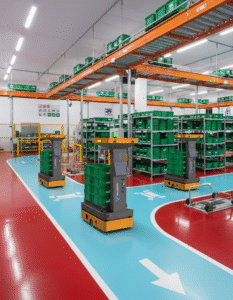
AMRs are intelligent, self-navigating robotic platforms that move goods through facilities using advanced indoor positioning, navigation, and safety sensors instead of fixed paths. Companies like Hachidori Robotics build India’s best Autonomous Mobile Robots for material movement , backed by three patents for indoor positioning and navigation .
Applications:
- Line-side material delivery in automobile and electronics manufacturing
- Intralogistics movements in FMCG and pharmaceutical warehouses
- Pallet, tote, or rack movement between storage, picking, and shipping zones
- Feeding assembly lines and handling returns or replenishments
Business value:
- Fast, efficient, and reliable material movement
- Dynamic routing, robots choose optimal paths based on congestion and priorities
- Seamless integration with warehouse management systems (WMS) and manufacturing execution systems (MES)