
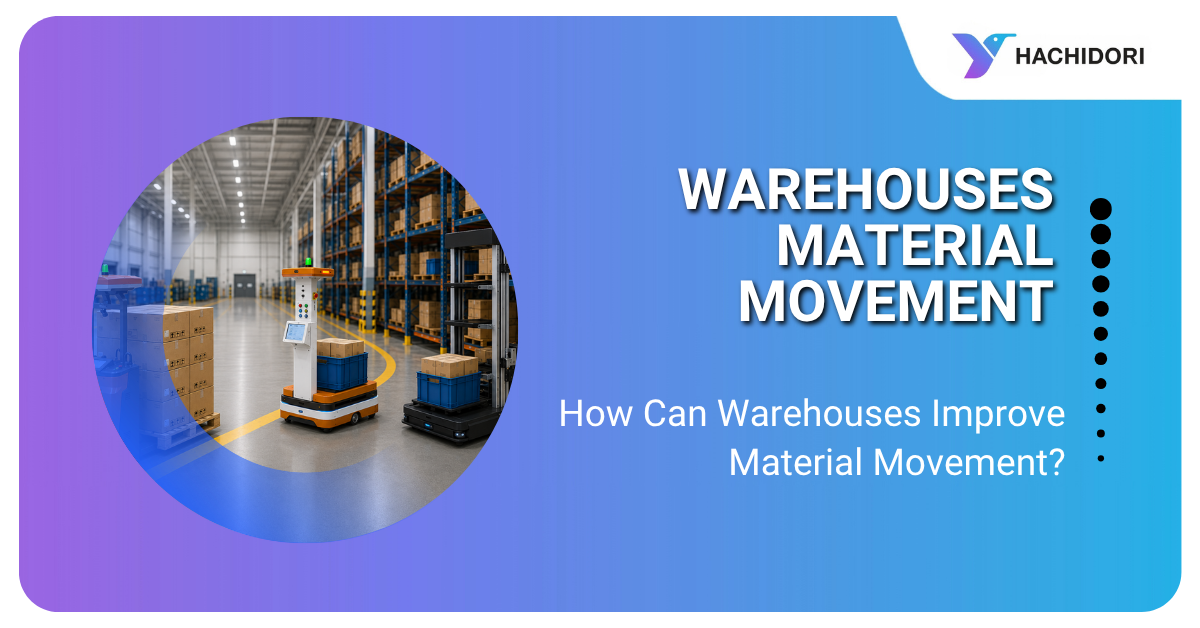
Efficient, well-designed warehouse material movement turns storage facilities from cost centers into productivity engines. When goods flow smoothly, orders are fulfilled faster, workers are safer, and operations are ready for growth.
Modern warehouses and manufacturing plants now rely on a mix of smart layouts, ergonomic equipment, and automation, including Automated Mobile Robots (AMRs) from companies like Hachidori Robotics to achieve fast, reliable, and scalable material flow.
Why Material Movement Matters in Warehouses?
Material movement is the backbone of every warehouse and factory. It connects receiving, storage, picking, packing, and dispatch. When this flow is smooth, everything else works better.
Strong warehouse material movement delivers:
- Faster order processing and shorter lead times
- Lower handling costs per unit
- Safer working conditions and fewer injuries
- Higher warehouse productivity and asset utilization
Hachidori Robotics focuses on this core problem moving goods quickly, efficiently and reliably within factories and warehouses using India’s best automated mobile robots for material movement tailored to industries like automotive, FMCG, electronics manufacturing, pharmaceuticals, and general warehousing.
Common Warehouse Material Movement Challenges
Many facilities still depend heavily on manual handling and basic equipment. This creates operational friction and cost. Typical pain points include:
- Slow warehouse operations
Manual transport of pallets and bins with basic pallet jacks or trolleys slows down throughput, especially over long distances or multiple floors. - Manual handling inefficiencies
Workers spend significant time walking, pushing, and lifting, instead of focusing on value-added tasks like quality checks or exception management. - Worker fatigue and safety risks
Continuous pushing of heavy carts, lifting loads, and repetitive movements increase fatigue, injury risk, and absenteeism. Over time, this impacts performance and retention. - Warehouse congestion and traffic conflicts
Unplanned routes, narrow aisles, and mixed equipment (forklifts, trolleys, people on foot) lead to bottlenecks, near misses, and productivity losses. - Delayed inventory movement
Slow movement from production lines to storage, or from storage to dispatch, causes order delays, poor space utilization, and higher working capital. - High labor costs
When the only way to move material is “more people” and “more shifts”, operating costs escalate, especially for large sites or multi-plant operations. - Product damage risks
Unstable loads, manual stacking, and inconsistent handling increase damage to cartons, drums, and fragile products critical for industries like electronics and pharmaceuticals. - Operational downtime
Breakdowns of key equipment, unavailability of operators, or process bottlenecks can stall entire lines or shifts, especially in high-volume manufacturing.
Ways to Improve Material Movement:
Improving warehouse material handling doesn’t require a complete overhaul on day one. A structured approach combining layout optimization, right-sized equipment, and progressive automation works best.
- Optimize Warehouse Layout and Flow
A good layout removes unnecessary movement and reduces congestion.
Key strategies:
- Design clear, dedicated paths for people, forklifts, and AMRs
- Place fast-moving SKUs closer to dispatch and picking zones
- Use visual management (signage, floor markings) for routes and zones
- Minimize cross-traffic between inbound, storage, and outbound areas
For example, many Hachidori customers in manufacturing and warehousing redesign flows so raw materials, WIP, and finished goods move in defined loops serviced by material movement systems instead of ad hoc manual routes.
- Use the Right Manual and Semi-Automated Equipment
Before full automation, it’s essential to deploy the right equipment for each task.
Typical options include:
- Pallet jacks and stackers for short-distance pallet moves and vertical storage
- Conveyors and dock conveyors for continuous flow between packing, sortation, and dispatch zones (e.g., solutions similar to “Jumbo Dock & Conveyor”)
- Tuggers and tow trucks for milk-run replenishment to lines and workstations (reflected in products like “Tugger”)
- Lift assist devices and lifters (such as “Appu lifter” or “APJ lifter”) to reduce manual lifting, improve ergonomics, and handle heavy or awkward loads
These tools directly reduce worker strain, speed up movement, and create more predictable routes and cycles.
- Standardize Material Movement Processes
Even without advanced automation, clear standards can transform performance:
- Define fixed intervals for replenishment runs and dispatch cycles
- Standardize loading patterns on pallets, bins, and trolleys
- Use checklists and SOPs for receiving, put-away, and line feeding
- Set KPIs such as “average time from pick to dispatch” or “line downtime due to material unavailability”
By measuring and standardizing, warehouses reveal where intralogistics optimization can deliver quick wins.
- Introduce Automated Mobile Robots (AMRs)
When facilities need scalable, reliable, and smart movement, warehouse automation solutions like AMRs become critical.
Companies such as Hachidori Robotics build India’s best AMRs specifically for indoor material movement. These robots:
- Navigate autonomously using advanced indoor positioning and navigation technology backed by multiple patents
- Move pallets, bins, carts, or shelves between zones with minimal human intervention
- Integrate with production lines, warehouse management systems, and conveyor networks
- Operate safely around people and other equipment, with obstacle detection and dynamic path planning
Examples of AMR-based solutions include:
- Low-profile pallet movers and platform AMRs for block-stacked pallets and heavy loads
- Slim, sleek bots for narrow aisles and constrained spaces
- Compact AMRs like “Zippi” or “LightWeight AMR” that handle totes, cartons, or small parts for electronics manufacturing or pharma
- Specialized lifter AMRs that can pick up and drop racks or trolleys automatically
By replacing repetitive manual movement with AMRs, warehouses improve consistency, safety, and capacity without linear increases in labor.
- Integrate AMRs with Conveyors and Dock Systems
The next step is connecting AMRs with existing material movement systems like conveyors and dock equipment.
Typical integration patterns:
- AMRs collect pallets or carts from conveyor line ends and transport them to storage or dispatch
- Robots feed packaging lines with cartons or components at fixed intervals
- Dock conveyors load/unload vehicles while AMRs handle in-warehouse distribution
This hybrid setup creates continuous end-to-end flow from line to dock, significantly boosting warehouse productivity .
Role of Automation in Warehouse Operations
Automation in warehouses now extends far beyond fixed conveyors and AS/RS systems. Flexible, mobile solutions like AMRs enable incremental deployment and give operations teams more control.
Key roles of automation:
- Reducing manual handling and fatigue
AMRs and lifters take over heavy and repetitive movements, allowing workers to focus on supervision, exception handling, and value-added tasks. - Decongesting aisles and improving safety
Automated routes, traffic control rules, and fleet management systems reduce random movements and near misses. Robots maintain disciplined flow and speed limits. - Accelerating inventory movement
By operating 24/7 or across multiple shifts, AMR fleets ensure raw materials, WIP, and finished goods are always in the right place at the right time. - Supporting multi-industry requirements
Hachidori Robotics deploys automation in automotive plants, FMCG warehouses, electronics manufacturing, and pharma facilities, each with specific material flow needs—from fragile components to high-throughput cartons and drums. - Enabling data-driven intralogistics optimization
Robots and automation systems generate valuable data: travel times, idle times, route utilization, bottleneck locations, and more. This visibility helps operations teams refine layouts, schedules, and resource allocation.
Benefits of Efficient Material Flow
When warehouse material movement is well-optimized and partially or fully automated, the benefits compound across the organization.
- Higher throughput and faster order cycles
Improved flow reduces dwell time at each stage. Orders move quicker from receipt to dispatch, enhancing customer experience and competitiveness. - Lower labor and handling costs
Automation and optimized equipment usage reduce the need for manual transport. Labor can be redeployed to higher-value roles, improving cost per unit handled. - Reduced product damage and quality issues
Stable, controlled movement, whether via conveyors, tuggers, or AMRs lowers the risk of drops, collisions, and improper stacking, essential for electronics and pharmaceuticals. - Improved safety and worker satisfaction
Less manual pushing and lifting means fewer injuries, lower fatigue, and better morale. This supports long-term retention and stronger safety culture. - Greater flexibility and scalability
Modular automation solutions like AMRs from Hachidori Robotics enable warehouses to scale capacity, extend routes, or add new lines without major structural changes. - Enhanced end-to-end supply chain visibility
Efficient material movement improves accuracy of inventory positions, cycle times, and capacity planning across manufacturing, warehousing, and logistics.
Choosing the Right Material Handling Solutions
Selecting the ideal mix of material movement systems for your facility starts with understanding your operations and pain points.
Consider the following:
- Current and future throughput
Measure daily and peak volumes, SKU profiles, and order patterns to estimate movement demand. - Distance and route complexity
Long-distance transport, multiple floors, and complex layouts benefit more from AMRs and conveyors than simple pallet jacks. - Load characteristics
Heavy pallets, fragile electronics, pharma drums, and FMCG cartons often require different equipment and safety standards. - Industry-specific requirements
Automotive plants might prioritize line-side replenishment; FMCG warehouses focus on high-velocity picking; pharma facilities require strict traceability and controlled handling. - Integration with existing systems
Evaluate how new solutions will connect with WMS, ERP, MES, and production lines to support seamless flow and data exchange. - Partner capabilities
Work with solution providers who can design, deploy, and maintain end-to-end warehouse automation solutions , including AMRs, lifters, tuggers, conveyors, and intralogistics consulting. Hachidori Robotics, for example, combines patented indoor navigation with domain expertise in manufacturing, warehousing, FMCG, electronics, and pharma to deliver robust material movement ecosystems.
Improving warehouse material movement is no longer optional, it’s central to competitive, resilient operations. By combining smart layouts, appropriate manual equipment, and scalable automation such as AMRs, warehouses and factories can overcome slow operations, manual inefficiencies, congestion, and high labor costs, while unlocking a safer, faster, and more profitable material flow.