
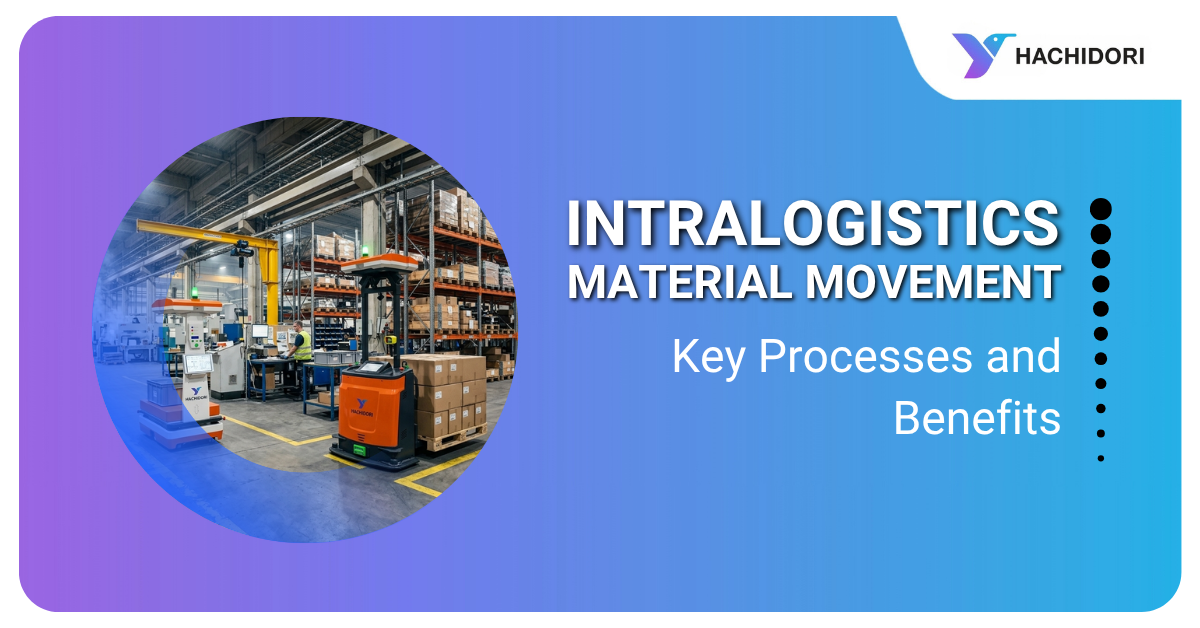
Choosing the right intralogistics material movement equipment is no longer just a procurement decision, it directly shapes your warehouse efficiency, labor costs, and ability to scale. For fast‑moving industries like automotive, FMCG, manufacturing, warehousing, electronics, and pharmaceuticals, the difference between manual handling and intelligent automation can be the difference between bottlenecks and a truly smart facility.
What Is Intralogistics Material Handling?
Intralogistics refers to all internal material movement within a facility from raw material receiving and line feeding to WIP transfer, finished goods dispatch, and returns handling. Intralogistics material handling equipment includes everything that moves, lifts, stores, or conveys goods inside your factory or warehouse.
Traditionally, this has meant a mix of pallet jacks, forklifts, conveyors, and manually pushed trolleys. Today, with the rise of industrial automation and warehouse automation equipment , intralogistics increasingly relies on Autonomous Mobile Robots (AMRs) and other smart systems that can:
- Navigate dynamically in changing environments
- Integrate with WMS/MES and ERP
- Reduce manual dependency and safety risks
- Improve throughput, space utilization, and process reliability
For companies like Hachidori Robotics , intralogistics is not just about moving goods; it is about orchestrating warehouse material movement with precision, speed, and reliability using patented indoor positioning and navigation technologies.
Types of Material Handling Equipment in Intralogistics
To choose the right intralogistics material handling equipment , it helps to understand the main categories and what problems they solve. At a high level, equipment is split into manual, semi‑automated, and fully automated solutions.
1. Manual and Conventional Equipment
These are common in most facilities and include:
- Hand trolleys, platform trucks, and pallet jacks
- Push carts for bin and carton movement
- Forklifts and reach trucks for pallet handling
- Static conveyor lines for point‑to‑point transfer
They are familiar, relatively low‑capex, but heavily dependent on operators. As operations scale, these systems often become the source of warehouse congestion , manual handling delays , and worker safety risks .
2.Semi‑Automated Systems
Semi‑automated intralogistics solutions bridge the gap between manual and full automation:
- Motorized pallet movers
- Powered conveyors with simple controls
- Standalone lifting tables and dock levelers
These reduce physical strain and increase speed, but they still need constant human supervision and do not optimize the end‑to‑end intralogistics flow
3. Automated and Intelligent Intralogistics Solutions
This is where intralogistics material handling equipment truly transforms operations:
- Autonomous Mobile Robots for flexible material movement
- AMR‑based tuggers for towing multiple carts in one route
- AMR‑powered unit load carriers (ULC) and pallet lifters for automated pallet handling
- AMR‑integrated dock & conveyor solutions for streamlined dock operations
- Smart bin ASRS systems for automated storage and retrieval
Modern AMRs, as built by Hachidori Robotics, are designed to:
- Operate with patented indoor GPS / navigation for precise positioning
- Handle loads ranging from light bins to heavy pallets and fixtures
- Safely co‑exist with human workers, reducing collision risks
- Offer flexible workflows—tugging, lifting, docking, conveying—within the same intralogistics ecosystem
For facilities plagued by inventory movement inefficiencies , high labor costs , and scalability challenges , these intelligent intralogistics solutions unlock step‑change improvements.
Factors to Consider When Choosing Intralogistics Equipment
Selecting the right material handling solutions starts with a clear understanding of your operation. Below are practical decision criteria tailored to Warehouse and Factory Managers.
- Warehouse Size and Layout
Consider:
- Total area and aisle width
- Number of zones (receiving, storage, picking, production, dispatch)
- Vertical storage (racks, mezzanines) and cross‑docks
Tightly packed facilities with narrow aisles and dynamic flows benefit from flexible AMRs that do not rely on fixed tracks or rails. Patented indoor navigation allows robots to re‑route around temporary blockages, maintenance zones, or seasonal inventory surges without redesigning the warehouse.
- Load Type and Handling Requirements
Analyze:
- Typical load formats: pallets, racks, bins, trolleys, fixtures
- Weight ranges from light electronics bins to heavy automotive sub‑assemblies
- Special constraints: fragile goods, contamination control, temperature‑sensitive inventory
For pallet‑heavy operations, AMR‑based pallet lifters or ULCs may be ideal. For line feeding in automotive or electronics manufacturing, tugger AMRs and on‑top load carriers offer efficient, repeatable routes without manual intervention. Pharmaceutical and FMCG environments often require hygienic, contact‑safe movement, where automated equipment minimizes human touchpoints.
- Throughput and Process Variability
Key questions:
- How many movements per hour do you need at peak?
- Are flows stable, or do routes change with product mix and seasonality?
- Do you operate single‑shift or multi‑shift, five or seven days a week?
If your facility frequently re‑configures lines, introduces new SKUs, or expands zones, fixed conveyors and rigid AGVs may struggle. Warehouse automation equipment that combines wireless natural navigation with configurable missions (like Hachidori’s AMR platforms) can adapt to evolving workflows with minimal downtime.
- Integration with IT/OT Systems
Modern intralogistics is only as powerful as its connectivity:
- WMS/MES integration for real‑time task allocation
- ERP visibility for order‑level tracking
- OT integration with production lines, scanners, and IoT sensors
When evaluating intralogistics solutions , ensure the equipment can exchange data with your existing systems, support fleet management, and provide dashboards for monitoring utilization, cycle times, and bottlenecks. This enables data‑driven decisions on route optimization, fleet sizing, and continuous improvement.
- Safety and Compliance
Worker safety is both a legal obligation and a productivity driver:
- Automated equipment should feature advanced obstacle detection and controlled speeds
- Safety certifications and risk assessments should be standard
- For pharmaceuticals and FMCG, equipment must support hygiene, contamination control, and traceability
Robotics‑based material handling solutions considerably reduce back injuries, collisions, and ergonomic strain by taking over repetitive and heavy movements while humans focus on supervision, quality, and exception handling.
- Scalability and Total Cost of Ownership (TCO)
Look beyond the initial purchase:
- How easy is it to add more units as volumes grow?
- Will you need major infrastructure changes to scale?
- What does maintenance, battery life, and service support look like over 5–7 years?
Flexible warehouse automation equipment such as AMRs provides scalable performance. Adding robots to a fleet is often faster than expanding conveyor lines or acquiring more forklifts and operators. The TCO often favors automation when you factor in labor costs, downtime, accidents, and the hidden cost of operational complexity.
Manual vs Automated Solutions: When to Upgrade
Many facilities sit at a crossroads: continue with manual handling or transition to automated intralogistics solutions . Here is a practical comparison.
Manual/Conventional Equipment:
- Lower upfront investment
- High dependency on skilled operators
- Vulnerable to labor shortages and absenteeism
- Higher risk of accidents, fatigue, and inconsistent performance
- Limited data visibility (manual logs, paper trails)
Automated Equipment (AMRs, smart conveyors, ASRS):
- Higher initial investment but strong long‑term ROI
- 24/7 availability and consistent performance
- Built‑in safety measures and ergonomics
- Rich data on movements, cycle times, queues, and asset utilization
- Highly scalable and adaptable to changing workflows
If your facility is already facing manual handling delays , warehouse congestion , and scalability challenges , automated warehouse material movement solutions are no longer a luxury, they are a competitive necessity.
A phased approach often works best: start by automating your most critical flows (e.g., pallet movement from receiving to storage, WIP movement between key lines) using AMR‑based equipment. Once you see measurable gains in productivity and safety, extend automation to more routes and processes.
Benefits of the Right Intralogistics Equipment Selection
Choosing the right intralogistics material handling equipment delivers tangible business benefits across operations.
- Improved Warehouse Productivity
Automated equipment reduces cycle times, eliminates idle waiting, and ensures materials reach the right station at the right time. This supports higher throughput, smoother line balancing, and reduced changeover delays. - Lower Labor Costs and Better Workforce Utilization
Robots take over repetitive travel and lifting, allowing staff to focus on exception handling, quality checks, and process optimization. This reduces reliance on seasonal labor and overtime, addressing high labor cost and availability issues. - Reduced Warehouse Congestion and Bottlenecks
Intelligent routing and fleet management prevent traffic jams and overlapping routes. AMRs dynamically choose paths based on real‑time conditions, freeing up aisles and docks for continuous flow. - Enhanced Worker Safety and Compliance
Automated material movement significantly lowers accident rates and musculoskeletal injuries. Safety‑engineered material handling solutions also help comply with occupational health, pharma, and food safety regulations. - Greater Inventory Movement Accuracy
Integrated systems ensure each movement is logged and traceable, reducing misplacements, wrong bin transfers, and stock discrepancies. In high‑value or sensitive sectors, this traceability is critical for audits and recalls.