
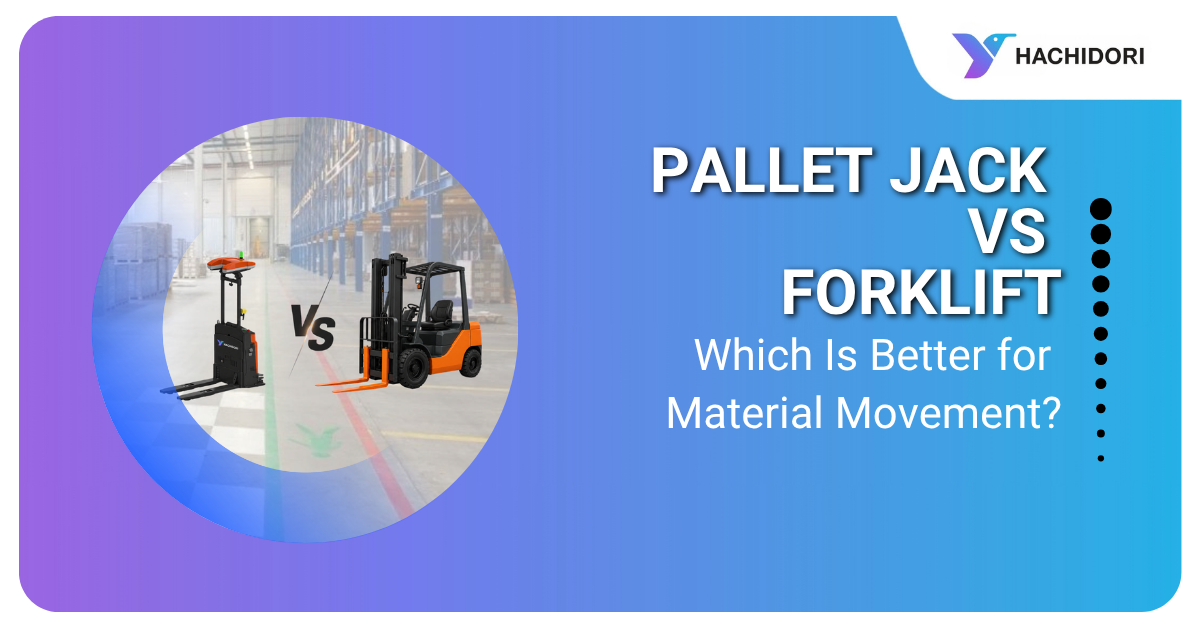
In modern warehouses and factories, the debate of pallet jack vs forklift is more than a simple equipment comparison, it’s a strategic decision that directly impacts operational cost, worker safety, and overall material flow efficiency. Warehouse managers, factory leads, and supply chain professionals today are under pressure to move more, faster, and safer, often within constrained spaces and budgets.
Choosing the wrong material handling equipment can lead to high operating costs, slow material transportation, excessive manual labor, and even safety incidents. On the other hand, selecting the right combination of pallet jacks, forklifts, and increasingly, autonomous mobile robots (AMRs), can unlock significant improvements in warehouse productivity and intralogistics performance.
In this blog, we’ll compare pallet jacks vs forklifts based on cost, operation, safety, load capacity, and warehouse applications and help you decide which is better suited for your facility.
What Is a Pallet Jack?
A pallet jack (also called a pallet truck) is a compact material handling equipment designed to lift and move palletized loads over short distances at ground level. It typically has a pair of forks that slide under a pallet and a hydraulic mechanism that slightly raises the load off the floor.
There are two broad categories of pallet jacks:
- Manual pallet jacks : Operated completely by human force. The operator pumps the handle to raise the pallet and pulls or pushes the load to its destination.
- Electric pallet jacks (powered pallet trucks) : Battery-powered movement and lifting reduce manual effort and enable faster, smoother material movement.
Typical pallet jack applications
Pallet jacks are widely used for:
- Loading and unloading pallets inside trucks and containers
- Moving goods from staging areas to racks or workstations (where vertical lifting is not required)
- Short-distance transport in retail backrooms, small warehouses, and light manufacturing units
- Tight spaces and narrow aisles where larger equipment cannot maneuver easily
Because pallet jacks operate at floor level and have limited lift height, they are best suited for horizontal warehouse material movement rather than vertical stacking.
What Is a Forklift?
A forklift is a powered industrial truck designed for lifting, transporting, and stacking heavy loads. Equipped with a mast and forks, forklifts can raise pallets and containers to significant heights, making them essential in racked warehouses and high-bay storage systems.
Common forklift types include:
- Counterbalance forklifts : The most widely used type, with a counterweight at the rear to balance heavy loads in front.
- Reach trucks : Designed for narrow aisles and high racking systems, with extended reach capabilities.
- Electric forklifts : Battery-powered units suitable for indoor operations and clean environments such as FMCG and pharmaceutical warehousing.
- Internal combustion forklifts : Fuel-powered forklifts used for outdoor yards and heavy industrial operations.
Typical forklift applications
Forklifts are predominantly used in:
- High-volume loading and unloading at docks and yard areas
- Stacking and de-stacking pallets into multi-level racks
- Handling heavy loads in manufacturing plants, automotive factories, and bulk warehousing
- Operations where both horizontal and vertical material handling are required
Forklifts are the backbone of many traditional warehouse layouts, especially where storage density and vertical utilization of space are key priorities.
Key Differences Between Pallet Jacks and Forklifts
When comparing pallet jack vs forklift , it’s important to consider not only technical capabilities but also cost, safety, and the impact on workflow.
- Cost and Total Cost of Ownership
- Pallet jacks
- Lower acquisition cost, especially for manual units
- Minimal training requirements
- Lower maintenance and repair costs
- Ideal for facilities with budget constraints or low-volume operations
- Forklifts
- Higher upfront investment
- Ongoing costs for energy/fuel, maintenance, and operator training
- May require special infrastructure, charging stations, or refueling points
- Better suited for high-throughput environments where the productivity gain offsets the cost
For organizations struggling with high operational costs , starting with pallet jacks can be attractive. However, in high-volume environments, the greater throughput and versatility of forklifts often justify the investment.
- Load Capacity and Reach
- Pallet jack benefits
- Effective for low to moderate loads, typically up to 2–3 tonnes depending on model
- Movement restricted to ground level with minimal lift height
- Ideal for dock-to-staging movements and floor storage
- Forklift applications
- Capable of handling heavier loads across a wide range of capacities
- Significant lift height to reach upper rack levels
- Essential in operations with tall racking, mezzanine storage, and bulk stacking
If your material movement involves heavy loads and vertical lift, a pallet jack alone will be insufficient. In this context, forklifts are the primary choice for industrial material handling .
- Operation and Workflow Impact
- Pallet jacks
- Simpler, low-complexity operations
- Suitable for short and frequent trips
- Less disruptive to pedestrian areas due to smaller footprint and lower speed
- Best fit for manual or semi-automated workflows where workers handle picking and packing, and pallet jacks handle movement
- Forklifts
- Central to structured intralogistics, especially in high-density warehouses
- Higher speed and throughput per trip
- Require dedicated paths, safety zones, and traffic management
- Strong impact on , as many processes are designed around forklift operationswarehouse workflows
In highly dynamic environments where space is limited and human workflows dominate, pallet jacks may integrate more easily. In large-scale, standardized operations, forklifts drive greater efficiency.
- Safety Considerations
Safety is a major concern for warehouse material movement and industrial material handling .
- Pallet jacks
- Lower operating speed
- Reduced risk of severe accidents compared to forklifts
- However, manual handling can lead to fatigue, ergonomic issues, and strain injuries, especially when loads are heavy or movement is frequent
- Forklifts
- Higher potential risk due to speed and mass
- Require trained, certified operators
- Need strict safety protocols: speed limits, warning systems, clear aisles, pedestrian segregation
- Well-managed forklift fleets can significantly improve safety by reducing heavy manual lifting, but poor control can lead to accidents
For organizations concerned about worker safety and excessive manual labor , a balanced approach combining powered pallet jacks, forklifts, and increasingly, automated mobile solutions is recommended.
- Space Utilization and Warehouse Layout
- Pallet jacks
- Excellent for narrow aisles, compact spaces, and small facilities
- Can navigate tighter areas where forklifts cannot operate safely
- Are well-suited to operations with ground storage and minimal vertical stacking
- Forklifts
- Require wider aisles and turning radii
- Enable high-density vertical storage, improving space utilization
- Influence rack design, aisle width, and layout planning
If limited warehouse space is your primary challenge, the decision is nuanced. Pallet jacks can operate in tighter spaces at ground level, but forklifts unlock vertical space. Increasingly, warehouse automation strategies combine forklifts or reach trucks for vertical movement and AMRs for horizontal material movement to optimize both volume and flow.
Advantages of Pallet Jacks
Understanding pallet jack benefits helps clarify where they outperform forklifts:
- Low acquisition and operating cost : Ideal for small to mid-sized facilities and cost-conscious operations.
- Simple training and operation : Easy adoption across teams without extended training programs.
- High maneuverability in tight spaces : Perfect for small warehouses, retail backrooms, and dense staging areas.
- Lower infrastructure requirements : No special charging stations needed for manual units.
- Good for short, repetitive moves : Especially dock-to-staging, staging-to-line, or internal transfers at ground level.
For many organizations, pallet jacks are the first step in professional material handling equipment adoption, replacing pure manual handling with a simple yet effective tool.
Advantages of Forklifts
On the other hand, forklift applications cover a broader and more demanding range of needs:
- High load capacity and vertical reach : Essential for stacked storage and tall racks.
- Higher throughput per trip : Suitable for high-volume receiving and dispatch operations.
- Versatility across environments : From indoor warehousing to outdoor yard operations.
- Critical for racked and high-density warehouses : Any warehouse relying on vertical storage depends on forklifts or similar equipment.
- Integration with structured intralogistics : Forklifts can be coordinated with dock operations, production lines, and staging zones to create efficient material flow.
For larger manufacturing plants, automotive factories, FMCG distribution centers, and electronics manufacturing facilities, forklifts are indispensable in achieving predictable, high-performance industrial material handling .