
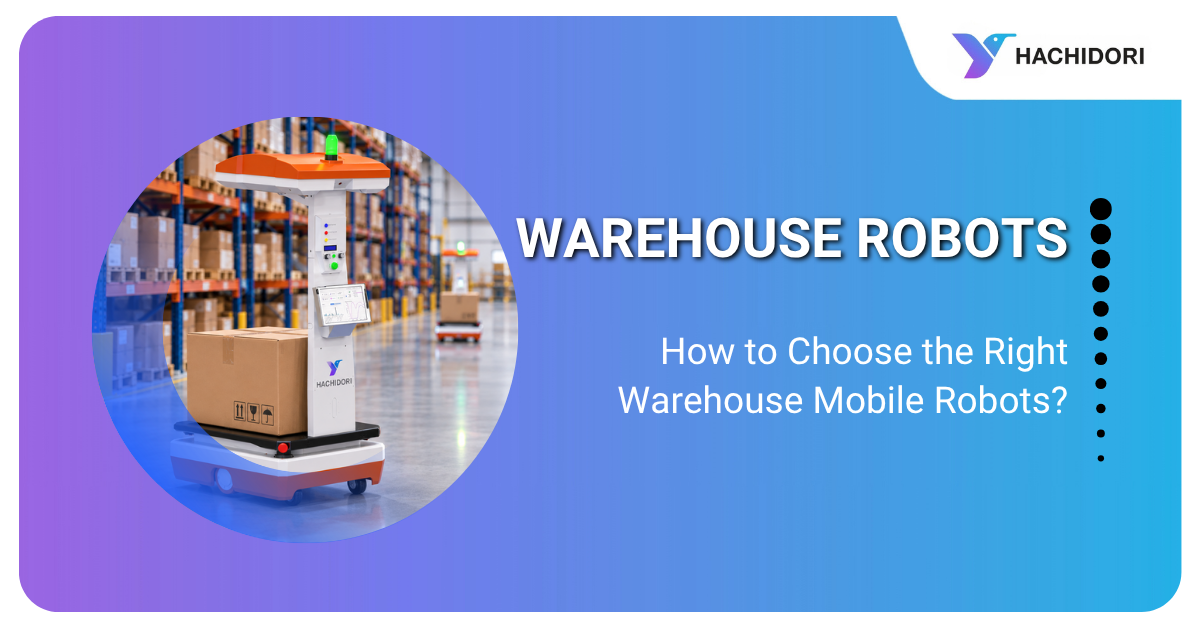
Choosing the right warehouse AMR (warehouse robots) is no longer a “nice to have” decision ,it directly impacts throughput, labour efficiency, and safety inside your facility. Hachidori Robotics, a Bengaluru-based AMR manufacturer, builds India’s best Autonomous Mobile Robots for intralogistics and has deployed them across manufacturing, warehousing, electronics, FMCG and pharmaceutical environments. Using these real-world insights, this guide helps you move from “Do we need an AMR?” to “Which AMR configuration is right for our warehouse?”
What Is an AMR and Why Does the Right Selection Matter?
An Autonomous Mobile Robot (AMR) is a self-navigating warehouse robot that uses sensors such as 2D LiDAR, 3D depth cameras and sensor fusion to understand its environment and move loads without tracks or fixed floor infrastructure. For warehouses and factories, AMRs typically handle pallet movement, trolley/tote transport, WIP (work-in-progress) movement, and dock-to-rack flows.
Selecting the right warehouse AMR matters because:
- The wrong payload capacity can create bottlenecks, underutilised robots, or unsafe operations.
- Inadequate navigation technology struggles with narrow aisles, mixed traffic, and dynamic layouts ,common in Indian warehouses.
- A mismatch between AMR applications and your processes leads to low utilisation and poor ROI, even if the robot is technically “working”.
Hachidori’s fleet, for example, spans sub‑50 kg to 4,000 kg load capacities and multiple form factors (unit load carriers, tuggers, pallet jacks, dock & conveyor solutions), specifically to address diverse intralogistics scenarios.
Comparison Table: AMR Types for Warehouses
Below is a simplified comparison of common warehouse automation robots used in intralogistics, based on typical AMR configurations like those deployed by Hachidori Robotics.
| AMR Type | Typical Use Case | Payload Range (Indicative) | Best For |
| Unit Load Carrier (ULC) | Totes, cartons, bins movement | Sub‑50 kg to ~200 kg | E‑commerce, FMCG, electronics picking zones |
| Tugger / Tugger AMR | Towing multiple trolleys or carts | Few hundred kg to >1,000 kg | Line-side feeding, WIP trains |
| Autonomous Pallet Jack | Pallet lifting, transport, dock-to-rack movements | Up to 1.5–4 tons | Warehousing, manufacturing, distribution |
| Dock & Conveyor AMR | Automated infeed/outfeed at docks, ASRS integration | Varies with line design | Cross-docking, ASRS, high-throughput hubs |
Use this table as a first filter: match your dominant flow (totes vs pallets vs trolleys) to the closest AMR type, then refine payload and navigation details.
8 Factors to Consider When Choosing a Warehouse AMR
When building an AMR selection guide , warehouse managers should systematically evaluate:
- Payload capacity (weight, dimensions, centre of gravity).
- Navigation technology and ability to handle dynamic layouts.
- Applications and workflows (picking, replenishment, cross‑docking, WIP movement).
- Warehouse layout and aisle constraints .
- Battery runtime and charging strategy .
- Safety systems and obstacle detection .
- Integration with WMS/WES/MES and other automation (ASRS, conveyors) .
- Business case and ROI (labour, throughput, error reduction).
Hachidori’s deployments across manufacturing and warehousing show that mature AMR programs score well on all eight dimensions, not just one or two.
How to Choose AMR Payload Capacity?
AMR payload capacity is one of the most critical decisions in warehouse AMR selection. Hachidori’s robots, for instance, cover load capacities from sub‑50 kg to several tons to support use cases ranging from tote movement to heavy pallet transport.
Use this simple checklist for AMR payload capacity :
- List your top 5–10 recurring material movement tasks (e.g., “pallet from receiving to bulk storage”, “tote from pick tower to packing”).
- Record average, minimum, and peak load weights for each task.
- Consider load dimensions (length, width, height) and any overhanging packaging.
- Identify if loads are single (one pallet/trolley) or grouped (tugging multiple carts).
- Add a safety margin (typically 10–20%) above peak weight to avoid overloading.
If your operation frequently moves mixed loads (e.g., light totes plus heavy pallets), multi‑platform fleets like Hachidori’s ,combining unit load carriers, tuggers, and pallet AMRs ,provide better coverage.
Choosing the Right AMR Navigation Technology
Navigation is the backbone of autonomous mobile robots for warehouse operations. Hachidori’s AMRs use patented Wireless Natural Navigation (WiNN) technology for track‑free movement in dynamic environments.
Key questions for AMR navigation selection:
- Do you have fixed, predictable paths or highly dynamic, changing routes?
- Are aisles narrow, with mixed human–robot–forklift traffic?
- How frequently do you rearrange racks or add new zones?
Robust navigation should:
- Operate without magnetic tapes or floor markers, reducing installation and maintenance overheads.
- Reliably handle narrow gangways and complex layouts typical in Indian warehouses and factories.
- Use sensor fusion (LiDAR + cameras) for real‑time obstacle detection and safe path planning.
If your warehouse is undergoing frequent layout changes or you plan progressive automation, prioritise flexible navigation over fixed infrastructure systems.
Selecting an AMR Based on Warehouse Application
Successful AMR applications align directly with business workflows. Hachidori’s industry pages show typical applications such as raw material transportation, WIP movement, line‑side replenishment, inspection support, and finished goods transfer across manufacturing, warehousing, FMCG, electronics, and pharma.
Map your warehouse applications using this checklist:
- Inbound: dock‑to‑rack pallet movements, put‑away, cross‑docking.
- Storage: replenishment to pick faces, buffer movements.
- Picking: tote/cart movement between zones, zone‑to‑packing transfers.
- Outbound: consolidation, staging, and dock loading.
- Inter‑process flows: line‑side feeding, WIP transfer between production steps.
Then match each application to an AMR type:
- High‑volume pallet flows → Autonomous pallet jack AMRs.
- High‑mix, small loads → Unit load carriers for totes and cartons.
- Route‑based WIP transfers → Tuggers and towing AMRs.
- Dock/ASRS interfacing → Dock & conveyor AMRs integrated with automation systems.
AMR Size and Warehouse Layout
Physical size and turning radius of the warehouse robots are crucial, especially in brownfield sites. Hachidori explicitly highlights suitability for narrow aisles and mixed traffic environments in India.
Consider:
- Minimum aisle width the AMR must handle (including human and forklift co‑traffic).
- Types of intersections (T‑junctions, cross aisles, blind turns).
- Vertical constraints (ramps, level differences, dock plates).
For dense storage or older facilities, smaller footprint AMRs (e.g., lightweight platforms like Hachidori’s LightWeight AMR Robot for tote movement in narrow gangways can unlock automation where traditional AGVs struggle.
Battery Runtime and Charging Requirements
Battery performance affects throughput and availability of warehouse automation robots. While specific runtimes vary, best‑practice patterns from AMR deployments include:
- Designing for multi‑shift operations with opportunity charging during breaks and low‑traffic windows.
- Using fleet management software to schedule charging intelligently and avoid simultaneous downtime.
- Matching battery capacities to travel distances and load profiles typical of manufacturing, FMCG, warehousing, and pharmaceuticals.
Ask vendors to provide scenario‑based battery estimates (e.g. “8‑hour two‑shift operation with X km/day and Y kg average load”) rather than generic runtime figures.
Safety and Obstacle Detection
Safety is non‑negotiable in AMR deployments. Hachidori’s AMRs use onboard sensors (LiDAR, depth cameras and sensor fusion) to detect obstacles and navigate safely in mixed-traffic environments.
For your warehouse AMR selection, check:
- Compliance with relevant safety standards and local regulations.
- Presence of 360° obstacle detection and safe stopping distances.
- Behaviour in shared zones with pedestrians and manual equipment.
- Configurable speed limits for different areas (e.g. docks vs pick aisles).
In industries like FMCG, pharmaceuticals and electronics, where hygiene and product safety are critical, reducing human contact through AMRs also contributes to safer operations overall.
AMR Integration With WMS/WES/MES
True intralogistics automation happens only when warehouse robots are integrated with digital systems. Hachidori Robotics emphasises seamless WMS integration and real‑time fleet management as key elements of its AMR solutions.
When evaluating integration capabilities:
- Confirm support for your existing WMS/WES/MES or APIs for custom integration.
- Ensure AMRs can receive tasks triggered by inventory movements, orders, or production events.
- Ask about connectors to ASRS, conveyors, and other automation used in your warehouse.
- Evaluate dashboards for monitoring fleet health, task status, and bottlenecks.
Well‑integrated AMRs allow managers to see end‑to‑end material flow, which is critical in complex manufacturing and 3PL environments.
How Much ROI Can an AMR Deliver?
You must quantify the business impact of warehouse AMR deployments. Case studies across automotive, FMCG, electronics, pharmaceuticals and manufacturing show improvements in:
- Labour optimisation: fewer non‑value‑adding walking/transport tasks for operators.
- Throughput and TAKT time: faster, more predictable material movement to and from lines and pick zones.
- Error reduction: fewer mis‑routes and missed picks due to system‑directed flows.
- Safety and hygiene: reduced human presence in sensitive or high‑risk zones.
Hachidori have successfully deployed AMRs in multiple verticals with configurable payloads (200 kg to 1.5 tons and beyond) and flexible navigation, creating strong ROI for Indian warehouses and factories.
AMR Selection Checklist (For Warehouse & Manufacturing Managers)
Use this concise checklist when shortlisting warehouse robots and finalising your AMR selection guide :
- Warehouse AMR use cases defined: Inbound, storage, picking, outbound, WIP flows documented.
- Payloads mapped: Weight and size profiles for all key movements, plus safety margins.
- AMR type chosen: Unit load carrier, tugger, autonomous pallet jack, dock & conveyor matched to workflows.
- Navigation fit confirmed: Ability to handle narrow aisles, dynamic layouts, mixed traffic, and future expansion.
- Layout constraints analysed: Aisle widths, intersections, ramps, docking points reviewed.
- Battery strategy set: Runtime expectations, charging plan, and fleet utilisation model agreed.
- Safety validated: Sensor suite, stopping behaviour, speed limits, and compliance documented.
- Integration assessed: WMS/WES/MES and automation interfaces (ASRS, conveyors) planned.
- Industry requirements covered: Hygiene, contamination control, traceability for FMCG, electronics and pharma addressed.
- ROI model built: Baseline metrics for labour hours, throughput, error rates, and safety incidents defined and linked to AMR deployment targets.
By approaching warehouse AMR selection as a structured buyer’s guide rather than a hardware purchase, warehouse and manufacturing leaders can confidently move from “Do we need an AMR?” to “Exactly which AMR configuration, payload, navigation, and application stack is right for our warehouse.”