
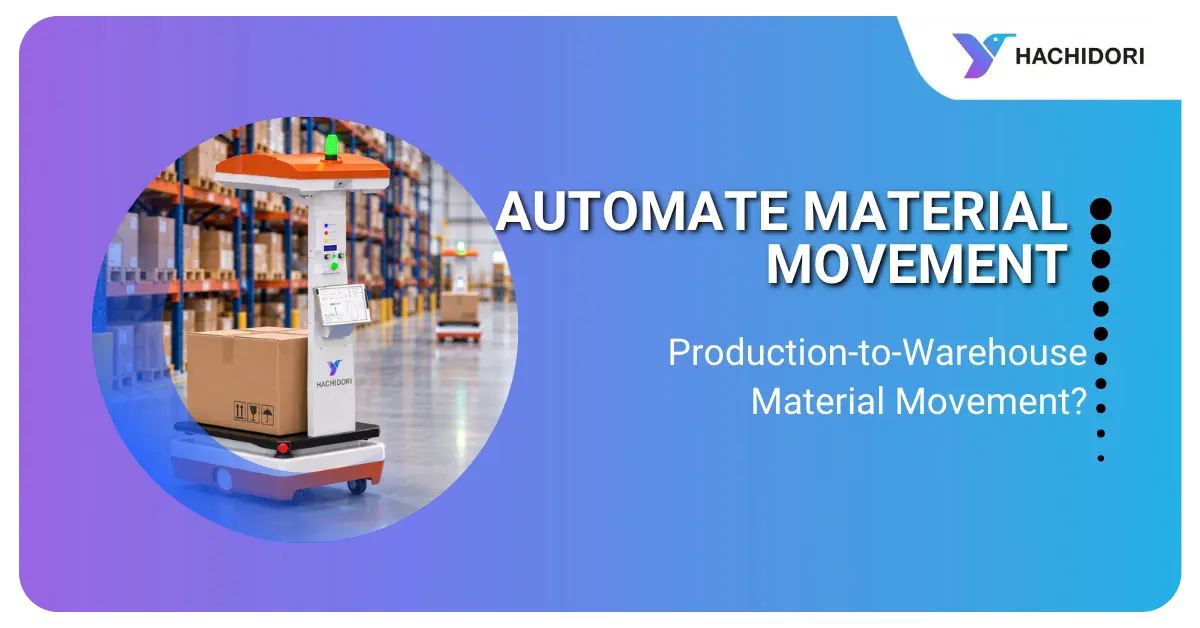
Autonomous Mobile Robots (AMRs) are redefining how factories and warehouses move materials between production lines and storage. For plant heads and production managers struggling with manual movement and line stoppages, AMRs offer a practical way to create a continuous, automated material flow from production to warehouse and back, with minimal human intervention.
What Is the Production-to-Warehouse Material Movement?
Production-to-warehouse material movement covers all internal transfers of goods inside your plant and logistics network, including movement of raw materials from stores to lines, work-in-progress (WIP) between processes, and finished goods from production lines to staging, AS/RS, or dispatch.
Typical flows include:
- Raw materials and kits from warehouse to production lines
- WIP transfer between workstations and intermediate buffers
- Finished goods from end-of-line to storage, QA, or outbound docks
- Return of empty pallets, bins, and trolleys back to the warehouse
In many factories, these flows are still handled by:
- Manual trolleys and pallet jacks
- Dedicated forklift operators
- Line helpers doing repeated “milk runs”
This creates a high dependency on people and static equipment to keep material flowing.
Challenges of Manual Material Transfer
When material transfer is manual, plant and warehouse performance is limited by people, paperwork, and unstructured workflows. Common pain points for plant heads and production managers include:
Delays causing line stoppages
Manual runners, forklifts, and tuggers are often shared across lines and departments. If a forklift is busy elsewhere or an operator is unavailable, raw materials and WIP arrive late, triggering micro-stoppages, idle time, and changeover delays.
Lack of visibility and traceability
Paper-based or ad-hoc movement makes it hard to know where a pallet or kit is at any moment. Production supervisors may not know whether material is still in stores, in transit, or stuck at a staging area, leading to over-ordering or last-minute firefighting.
High labor dependency and variability
Manual material movement is labor-intensive and sensitive to absenteeism, shift changes, and fatigue. In 3-shift operations, maintaining consistent throughput with human-driven logistics becomes challenging and expensive.
Safety risks and traffic congestion
Forklifts and manually pushed trolleys share aisles with pedestrians, increasing the risk of collisions. In dense layouts, visibility is poor and near-miss events are frequent, especially during shift change peaks.
Inefficient use of equipment
Traditional conveyor lines or fixed AGV paths are hard to reconfigure when layouts change. As product mix and volumes evolve, fixed automation becomes a bottleneck instead of an enabler.
All of this results in:
- Production delays and frequent line stoppages
- Excess WIP and inventory “just in case”
- Higher operating cost per unit
- Difficulty scaling throughput without adding people
How AMRs Automate Material Movement?
Autonomous Mobile Robots (AMRs) are purpose-built to automate internal transport of materials within factories and warehouses. Instead of humans pushing trolleys or driving forklifts, AMRs move pallets, bins, and trolleys safely and autonomously between production and warehouse zones.
Modern AMR platforms, such as those built by Hachidori Robotics, are engineered specifically for industrial material movement and intralogistics. They use a combination of:
- Patented indoor positioning and navigation for high-precision movement in dynamic environments
- Onboard sensors (like lidar and cameras) for obstacle detection and safe human collaboration
- Fleet management software to orchestrate multiple robots across production lines and warehouses
- Integration with WMS, MES, and ERP systems to trigger missions automatically, based on orders and production events
Hachidori Robotics, in particular, focuses on AMRs for material movement across industries such as automotive, FMCG, electronics, pharmaceuticals, and general manufacturing. Their robots cover a wide range of load capacities and use cases, from lightweight unit load carriers to heavy-duty pallet movers and dock-and-conveyor solutions for warehouse operations.
By replacing manual logistics with AMR-based automation, plants can:
- Ensure consistent, on-time movement of raw materials, WIP, and finished goods
- Reduce dependency on manual labor and forklifts
- Adapt faster to layout changes and new production lines
- Scale throughput without proportionally increasing manpower
AMR Workflow Between Production and Warehouse
To understand how AMRs create a continuous material flow, it helps to visualize a typical end-to-end workflow between production and warehouse.
- Inbound Material from Warehouse to Production
Step 1: Order or production plan triggers a mission
An order in the WMS/MES (for example, a production order for a specific model or SKU) triggers an AMR mission for raw materials or kits. The AMR receives a task such as “Pick pallet A from location W-01 and deliver to line L-03.”
Step 2: AMR picks up the load
Depending on the solution, AMRs can:
- Tug trolleys and kitting carts
- Lift pallets using top-lift or fork attachments
- Dock under specially designed racks or conveyors
Step 3: Autonomous navigation to the line
Using their indoor positioning and navigation system, AMRs navigate dynamic aisles, crossing with workers, forklifts, and other equipment. They automatically slow down or reroute when obstacles are detected.
Step 4: Delivery and confirmation
The AMR stops at the designated production station, buffer, or supermarket location. Once the material is unloaded or a docking sequence completes, the AMR updates the system (WMS/MES) that the task is complete and becomes available for the next mission.
- WIP Movement Between Processes
Intermediate moves between processes,such as machining to assembly, assembly to testing, or testing to packaging,are ideal for AMR workflows.
Typical WIP flow:
- AMRs pick up WIP racks or bins from one process
- Deliver them to the next process queue or buffer
- Coordinate with line-side sensors or operator call buttons (andon)
- Use priority rules to ensure critical WIP is expedited
This reduces manual shuttling and ensures that downstream machines are never starved for input.
- Finished Goods from Production to Warehouse
After packaging or final inspection, finished goods must move quickly to storage and dispatch areas.
A typical finished goods flow with AMRs:
- AMR receives a mission: “Collect pallet from end-of-line conveyor at P-05 and move to storage location S-12”
- Robot docks with the conveyor or pallet stand, picks the load, and travels to the warehouse
- At the warehouse, the pallet is delivered to a racking entry point, AS/RS interface, or staging zone
- The system updates inventory in real time, ensuring accurate stock levels for outbound planning
- Return of Empties and Reusable Assets
Effective intralogistics is not complete without return flows. AMRs can also:
- Return empty pallets, totes, and bins from lines back to the warehouse
- Deliver reusable packaging from unloading areas back to storage
- Balance racks and trolleys among different lines based on demand
This closes the loop and ensures the entire internal logistics chain is automated, not just one direction.
Key Benefits of AMR-Based Material Movement
For plant heads and production managers, AMR-driven automation delivers measurable improvements across operations, cost, and safety.
Continuous material flow and reduced line stoppages
With AMRs handling repetitive transport tasks, materials reach lines on time and in the right sequence. This reduces micro-stoppages and line waiting time, improving overall equipment effectiveness (OEE) and throughput.
Higher productivity and lower operating cost
By replacing manual movement with automated missions, the same workforce can handle more value-added tasks like quality checks, problem-solving, and changeover support. Material handling productivity rises, and cost per unit moved falls.
Scalable operations across shifts and demand peaks
AMRs can run across multiple shifts, supporting 24/7 operations. When demand spikes, additional robots can be added to the fleet more easily than hiring and training new operators.
Improved safety and compliance
AMRs operate with built-in safety features, including obstacle detection, speed limits, and safe stop zones. This reduces forklift traffic, cuts down on near-miss incidents, and supports safer shopfloor operations.
Flexibility for changing layouts and product mix
Unlike fixed conveyors or traditional AGVs, AMRs are not constrained by physical tracks or rigid paths. When you add a line, shift a workstation, or re-layout the warehouse, routes can be updated in software without major capex.
Better visibility and traceability
AMR fleets integrated with WMS, MES, and ERP systems provide real-time visibility of all material movements. Plant leaders gain dashboards showing where materials are, how long jobs take, and where bottlenecks occur.
Support for multiple industries and environments
With specialized platforms for different loads and use cases, AMRs from companies like Hachidori Robotics can be tailored to:
- Automotive and heavy engineering for pallet and fixture movement
- FMCG and food & beverage for high-speed, high-volume flows
- Electronics manufacturing for precise, delicate component handling
- Warehousing and e-commerce for dock-to-storage and order fulfillment
- Pharmaceuticals for hygienic and controlled material transport
How to Implement AMRs for Production-to-Warehouse Automation?
To successfully automate material movement with AMRs, it is important to follow a structured implementation roadmap.
- Map Your Current Intralogistics Flows
Start with a detailed assessment of your existing material flows:
- What are the key routes between warehouses and production lines?
- Which materials, SKUs, or WIP flows are causing frequent delays?
- Where do forklifts and trolleys spend most of their time?
- What is the typical cycle time and distance for each route?
This helps you identify high-impact use cases (e.g., raw material supply to bottleneck lines, finished goods transfer from high-volume packaging lines, etc.).
- Prioritize Use Cases and Define KPIs
Focus first on flows that:
- Directly affect line availability and throughput
- Involve repetitive, predictable routes and loads
- Are currently done manually or with forklifts
- Have clear targets (for example, 20% reduction in line stoppages or 30% reduction in manual movement)
Define KPIs such as:
- On-time delivery performance to lines
- Reduction in forklift runs
- Improvement in WIP turns
- Reduction in material handling labor hours
- Design Routes and Integration Points
Work with your AMR provider to:
- Define pick-up and drop-off points in both production and warehouse zones
- Design safe traffic rules and shared-aisle protocols with existing equipment
- Plan integration with WMS/MES for automatic mission triggering
- Include manual triggers (buttons, scanners, HMI panels) for operator calls
Specialized AMR types (tuggers, unit load carriers, dock-and-conveyor bots, etc.) should be matched to each route and load type.
- Pilot in a Controlled Area
Implement a pilot project in a defined area such as:
- One production line and its associated warehouse zones
- A single dock-to-storage workflow
- A specific WIP loop between two key processes
Use this pilot to validate:
- Safety and traffic behavior in real plant conditions
- Integration with existing IT/OT systems
- Operator acceptance and standard operating procedures (SOPs)
Measure the KPIs defined earlier and refine routes and rules.
- Scale Across Lines and Facilities
Once the pilot stabilizes and KPIs are achieved, extend AMR deployments to:
- Additional production lines and warehouses
- Multiple shifts and weekend operations
- New use cases like kitting, replenishment, and empty returns
Ensure your AMR partner can support multi-site fleets and centralized monitoring so that performance can be managed across the network.
- Continuously Optimize
AMR-based material movement is not a one-time deployment. Over time:
- Fine-tune missions and priorities based on evolving demand
- Add new drop-off points for new lines or warehouses
- Update traffic rules as layouts change
- Use analytics from the AMR fleet manager to identify further improvement opportunities
FAQs: AMRs for Material Movement Between Production and Warehouse
- Are AMRs suitable for brownfield factories with existing forklifts and conveyors?
Yes. AMRs are designed to coexist with existing equipment and infrastructure. They can gradually take over repetitive routes while forklifts handle exceptions, heavy lifts beyond AMR capacity, or outdoor movements. - What kind of loads can AMRs handle?
Industrial AMR portfolios typically cover a wide range,from sub-50 kg bins and totes to heavy pallets and fixtures in the 1–4 ton range. Different platforms (tuggers, unit load carriers, dock-and-conveyor bots) are selected based on your load types and workflows. - How do AMRs handle obstacles and people in the aisles?
AMRs use sensors such as lidar and cameras, combined with their indoor positioning system, to detect obstacles, slow down, reroute, or stop safely. They are built to operate in mixed environments where people and equipment are present. - How long does it take to implement AMRs in a running factory?
Timelines depend on the complexity of your layout and integration needs. A focused pilot in a defined area can often be deployed in a few weeks, with broader rollouts following after validation and optimization. - Can AMRs be used in industries with strict hygiene or regulatory requirements, like pharmaceuticals or food & beverage?
Yes. AMRs can be designed and configured to meet cleanroom standards, controlled environments, and specific regulatory requirements. For pharmaceuticals and FMCG, they help reduce human contact with sensitive materials and maintain consistent, traceable movement. - What skills are needed to operate and manage AMRs?
Operators primarily interact with AMRs through simple interfaces,call buttons, HMIs, or scanners. Fleet supervisors monitor dashboards for mission status and performance. Your AMR partner trains your team on basic operations and troubleshooting, while advanced configuration is typically handled by the provider or your automation team.