
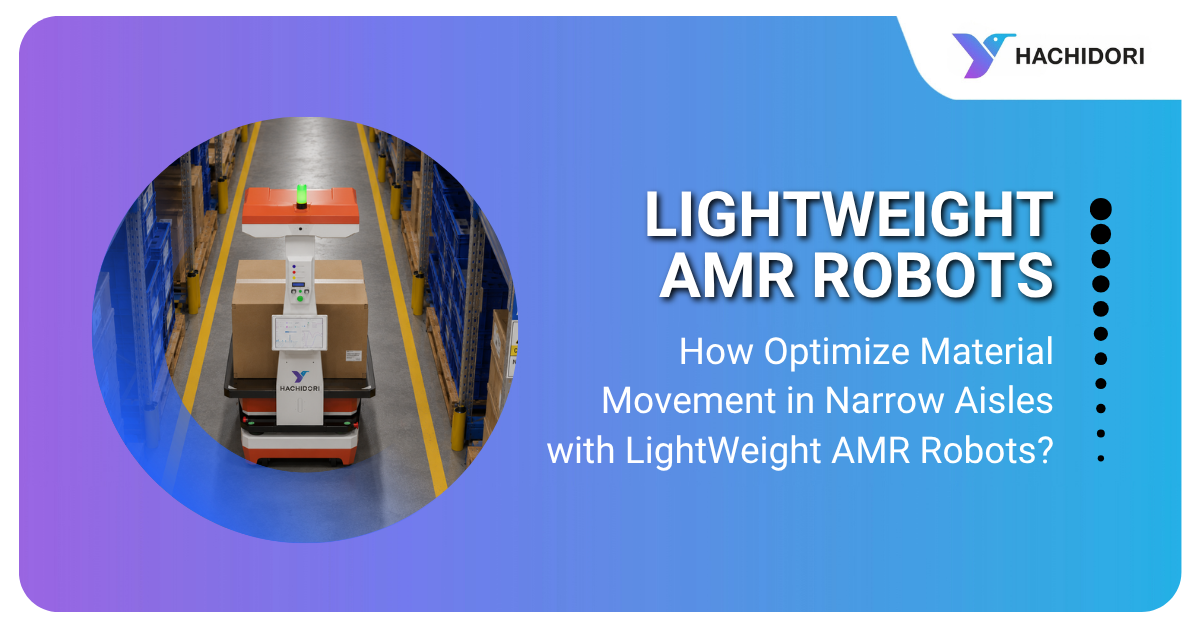
Efficient material movement in narrow aisles has become one of the most critical challenges for modern warehouses and manufacturing facilities. Limited space, congestion between racks, slow pallet transportation, and the difficulty of operating large equipment in tight lanes can quickly turn into operational bottlenecks, safety risks, and avoidable costs.
For companies managing high-throughput operations in automobile, FMCG, electronics, pharmaceutical, and general manufacturing, optimizing warehouse material movement is no longer optional, it is a competitive necessity. This is exactly where LightWeight Robots and narrow aisle material handling solutions transform intralogistics optimization from a pain point into a strategic advantage.
Why Narrow Aisles Create Big Problems in Warehouse Material Movement?
As organizations try to maximize storage density, aisles naturally become narrower. While this improves space utilization, it also introduces operational challenges in warehouse material movement :
In narrow aisle environments, traditional forklifts, pallet trucks, and large tuggers struggle to maneuver safely and efficiently. The turning radius of conventional equipment often exceeds the available space, forcing operators to slow down, reverse repeatedly, and perform complex maneuvers just to complete a simple material movement task. This leads to:
- Frequent congestion, especially during peak shifts, as multiple operators share the same narrow lanes.
- Slower pallet transportation and longer cycle times, impacting order fulfillment SLAs and production line feeding.
- Increased risk of product damage due to close proximity between equipment, racks, and goods.
- Higher worker safety risks, particularly around blind turns, intersections, and high-traffic cross-aisles.
For sectors like automotive manufacturing and electronics, where just-in-time inventory movement is critical, any delay in narrow aisle warehouse solutions directly impacts production continuity. For FMCG and pharmaceutical operations, inefficient inventory movement can impact freshness, compliance, and service levels.
The Role of LightWeight AMR Robots in Narrow Aisle Material Handling
Automated Mobile Robots (AMRs) designed specifically for material movement in narrow aisles offer a practical, scalable way to solve these challenges. A LightWeight AMR Robot is compact, agile, and purpose-built for operating in constrained spaces while maintaining high levels of throughput and safety.
Unlike traditional AGVs or manually operated equipment, Lightweight AMRs leverage advanced indoor positioning and navigation technologies to move accurately and autonomously in tight environments. Companies like Hachidori Robotics have gone a step further by owning multiple patents in indoor navigation, enabling precise movement even in complex layouts, high-rack warehouses, and dynamic industrial environments.
These robots are designed to:
- Navigate narrow aisles without requiring rail guidance or major infrastructure changes.
- Move pallets, bins, and materials between docks, staging areas, and production lines reliably.
- Operate safely alongside human workers, thanks to advanced obstacle detection and intelligent path planning.
By combining compact form factors with robust navigation capabilities, Lightweight AMR Robots become ideal building blocks for narrow aisle material handling strategies.
Key Pain Points in Narrow Aisle Material Movement and How Automation Solves Them
To truly optimize material movement in narrow aisles , it is important to address the specific problems that warehouse and manufacturing teams face every day. Below are the core pain points and practical automation-driven solutions.
-
Limited Warehouse Space and Congestion in Narrow Aisles
When space is constrained, storage density increases, and aisles get tighter. The result is frequent congestion, blocked paths, and delays in movement.
A LightWeight Robot minimizes this issue in several ways. Its smaller footprint allows it to glide through narrow spaces that would be challenging for larger forklifts or heavy tuggers. Intelligent fleet management systems ensure that multiple AMRs are dynamically routed to avoid traffic jams, while task queuing and prioritization minimize idle time.
In effect, you shift from a people-and-forklift-centric system to an automated intralogistics optimization model where robots are orchestrated to keep goods moving continuously without clogging critical paths.
-
Slow Pallet Transportation and Operational Bottlenecks
Slow movement between dock, storage, and production lines is a common bottleneck across manufacturing, warehousing, and logistics operations. In many facilities, manual pallet transportation consumes significant labor hours and introduces variability in cycle times.
Narrow aisle warehouse solutions built around AMRs streamline this process by automating repetitive, predictable movements. Robots can be assigned to dedicated routes—such as dock-to-staging, staging-to-rack, or rack-to-line feed ensuring consistent cycle times and reducing dependence on manual intervention.
Specific material handling modules like tuggers, lifters, and conveyors integrated with AMRs further enhance throughput. For example, an AMR equipped with a lifter can autonomously pick up and drop off pallets, while dock and conveyor integrations automate inflow and outflow between trucks and storage zones.
-
Difficulty Operating Large Equipment and Safety Risks
Large forklifts and manually operated tuggers are difficult to control in narrow aisles, especially when visibility is limited and racks are tall. This increases the chance of near misses, collisions, and ergonomic risks for operators.
AMR-based warehouse automation reduces these risks by shifting the responsibility of movement from human operators to intelligent machines. Safety scanners, 360-degree sensors, and advanced control algorithms help LightWeight Robots detect obstacles, slow down, stop, or re-route as required, lowering the probability of accidents.
In high-compliance industries like pharmaceutical and electronics manufacturing, where worker safety and product integrity are critical, this automation-driven safety layer becomes a core part of the narrow aisle warehouse solution.
-
Inefficient Inventory Movement and Product Damage
In traditional setups, inventory movement often relies on manual decisions what to move, when, and by whom. This leads to inconsistent flows, misplaced pallets, and higher risk of damage when goods are repeatedly handled.
By integrating autonomous mobile robots with warehouse management systems and manufacturing execution systems, facilities can automate inventory movement based on real-time demand signals. Robots move exactly what is needed, when it is needed, to the right location, reducing double-handling of goods and minimizing product damage.
When the same LightWeight Robot performs repeatable routes, such as replenishment from bulk storage to forward picking locations, the process becomes predictable and highly controllable, improving both service levels and inventory accuracy.
Practical Strategies to Optimize Material Movement in Narrow Aisles
To build a robust optimization plan for material movement in narrow aisles , warehouse and manufacturing decision-makers can adopt a structured approach that combines process redesign, equipment selection, and automation.
First, map current material flows in the warehouse: which goods move most frequently, which routes are congested, and where delays occur. This helps identify high-impact lanes and tasks that should be automated first.
Next, segment the environment into zones such as dock, storage, staging, picking, and production feed. In each zone, determine where narrow aisle material handling is most critical for example, dense pallet racking near production or deep lane storage near dispatch.
Once these areas are identified, deploy LightWeight AMR Robots to take over repetitive, high-volume routes. In manufacturing environments (automotive, electronics, FMCG), this might include line-side feeding and return of empty bins. In warehousing, AMRs can handle transfers between inbound dock, put-away zones, and order consolidation stations.
Supporting equipment such as lifters, tuggers, sleek platforms, and dock-integrated conveyors can be matched with specific robots to address different payloads and workflows. This ensures that every movement whether pallets, bins, or cartons has a dedicated automation solution suited to narrow aisles.
Finally, establish performance metrics for intralogistics optimization: robot utilization, cycle times between key nodes, congestion incidents, and material availability at consumption points. By continuously monitoring these KPIs and fine-tuning task assignments, warehouse operations professionals can sustain high levels of efficiency even as volumes grow.
Operational Benefits of LightWeight Robots in Narrow Aisle Warehouse Solutions
When implemented thoughtfully, AMR-driven warehouse material movement delivers benefits across multiple dimensions of operations.
In terms of space utilization, facilities can fully leverage narrow aisles and high-density storage without compromising on movement speed or safety. LightWeight Robots are designed to fit the constraints of such layouts, allowing organizations to store more inventory in the same footprint while maintaining reliable access.
From an efficiency standpoint, intralogistics optimization with AMRs reduces idle movement, manual walking, and non-value-added handling. Robots operate continuously and predictably, improving throughput and reducing cycle times for both manufacturing and warehousing processes.
Safety improves significantly as autonomous robots take over tasks that previously required workers to operate heavy equipment in tight spaces. Intelligent speed control, obstacle detection, and route planning minimize collision risks and protect both people and products.
Cost-wise, automation delivers long-term savings in labor for repetitive transport tasks, lowers damage rates, and reduces downtime due to congestion or accidents. In industries like automotive and FMCG, where margins are sensitive and volumes are high, these savings can be substantial.
Moreover, AMR-based warehouse automation provides scalability. As demand grows, facilities can add more robots to the fleet without redesigning the entire warehouse. Fleet management software ensures that additional units integrate seamlessly into existing workflows, maintaining balance and avoiding new bottlenecks.
Aligning Narrow Aisle Material Movement with Future-Ready Intralogistics
The trend toward compact, high-density warehouses and complex manufacturing intralogistics will continue. Organizations that proactively invest in narrow aisle warehouse solutions and LightWeight Robots position themselves to handle increasing volumes, shorter lead times, and greater variability without expanding physical footprints.
For Warehouse Managers, Logistics Managers, Supply Chain Teams, and Operations Professionals, the path forward lies in combining strategic layout design with intelligent automation. By focusing on material movement in narrow aisles as a core optimization area rather than treating it as a constraint, they can unlock significant gains in space utilization, operational efficiency, and safety.
Ultimately, LightWeight AMR-based warehouse material movement is not just a technology upgrade; it is a foundational shift in how intralogistics is orchestrated. With the right automation solutions, warehouses and manufacturing plants can transform narrow aisle operations from problem zones into high-performing, future-ready assets.