
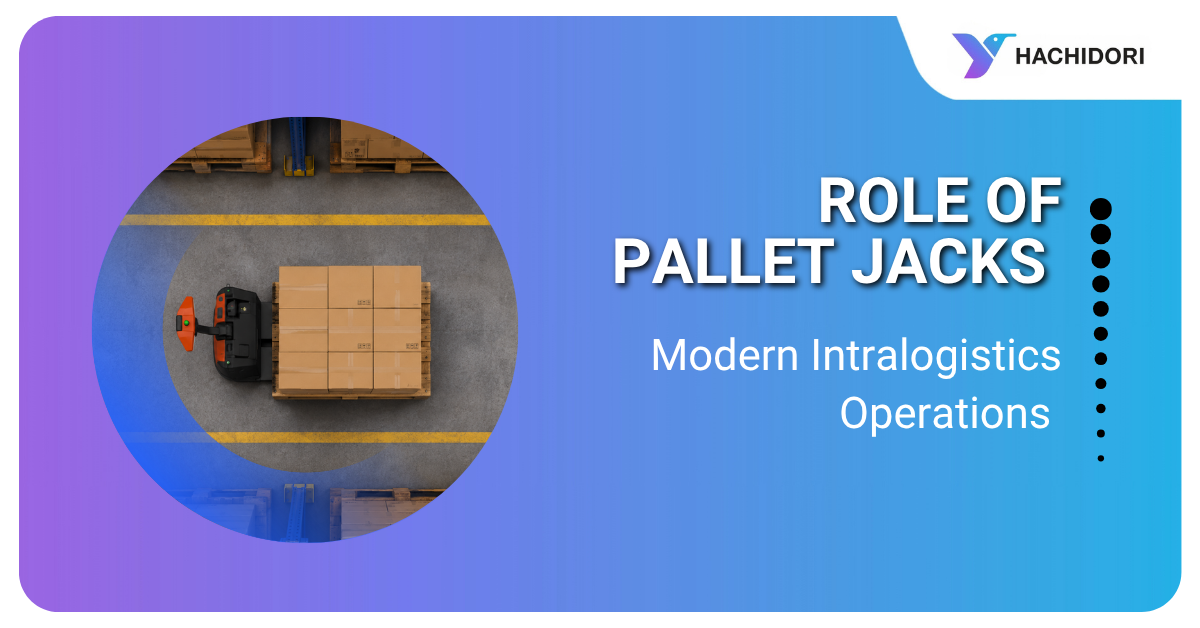
In modern warehouses and factories, pallet jack have quietly become one of the most critical tools for efficient intralogistics material handling and warehouse pallet movement. They sit at the intersection of speed, safety, and productivity directly impacting how fast goods move, how reliably orders are fulfilled, and how safely teams can operate on busy shop floors and in congested aisles.
For companies like Hachidori Robotics, which build India’s best Autonomous Mobile Robots (AMRs) for material movement, pallet jack are not just equipment; they are strategic enablers that connect manual operations with intelligent warehouse automation and material movement solutions.
What Are Pallet Jack?
Pallet jack, sometimes called pallet trucks or pallet movers, are pallet handling equipment designed to lift and move palletised loads over short to medium distances. They are used across intralogistics material handling workflows in manufacturing plants, FMCG warehouses, electronics manufacturing lines, and pharmaceutical facilities to move raw materials, work-in-progress items, and finished goods.
Traditionally, pallet jack have been:
- Manual pallet jack, where an operator pumps a handle to lift the pallet and then pulls or pushes it to the destination.
- Electric or powered pallet jack, which use a motor to assist in movement and lifting, reducing the physical effort required but still depending on an onboard operator.
In both cases, the core function is the same: lift the pallet securely, move it safely through the facility, and lower it for storage, staging, or dispatch. However, as intralogistics operations have become faster, denser, and more time-critical, traditional pallet jack have started to expose several pain points slow pallet transportation, worker fatigue, congestion, and higher risk of product damage.
Modern intralogistics operations now increasingly rely on autonomous pallet jack and AMR-powered pallet movers, such as those developed by Hachidori Robotics, which combine pallet jack functionality with advanced navigation, safety systems, and fleet management to deliver predictable, high-throughput pallet movement.
Importance of Pallet Jack in Intralogistics
Intralogistics refers to all internal material movements within a facility from receiving and put-away to line feeding, replenishment, picking, and dispatch. In this context, pallet jack play a central role in warehouse pallet movement and internal material flow.
Their importance can be understood across a few key dimensions:
First, pallet jack are the primary interface between storage locations and processes. Whether it is moving pallets from the inbound dock to storage racks, feeding pallets to production lines, or staging outbound loads near loading bays, pallet jack bridge every critical step of the intralogistics material handling cycle.
Second, they directly influence the speed and reliability of operations. Slow or inefficient pallet handling impacts replenishment times, causes operational delays and leads to missed dispatch windows. When pallet movement is fast, predictable, and safe, overall warehouse throughput improves, inventory turns accelerate, and production lines experience fewer stoppages.
Third, pallet jack affect workforce productivity and safety. Manual pallet jack require significant physical effort especially in large facilities where operators cover long distances multiple times per shift. Over time, this leads to worker fatigue, increased risk of musculoskeletal injuries, and higher chances of human error in congested environments. Smart pallet jack and autonomous pallet movers re-balance this equation by reducing manual strain and increasing safety margins through sensors, controlled speeds, and collision avoidance.
For industries that Hachidori Robotics serves automotive, FMCG, manufacturing, warehousing, electronics, and pharmaceuticals, pallet jack are not optional tools; they are essential elements of a resilient, high-performance intralogistics material handling framework.
Benefits of Pallet Jacs in Warehouse Operations
When deployed correctly, pallet jack unlock multiple operational benefits in warehouse operations and factory intralogistics. These benefits become even more pronounced when traditional pallet handling equipment is augmented or replaced by intelligent, autonomous pallet jack.
The first key benefit is improved material movement efficiency. Pallet jack simplify the movement of heavy, palletised loads without the need for larger equipment like forklifts, which may require more space and operator training. In narrow aisles, mezzanine floors, and dense storage areas, pallet jack provide agile, controlled mobility, making it easier to maintain continuous flow.
The second benefit is reduced manual handling inefficiencies and worker fatigue. Instead of operators pushing and pulling loads across long distances, autonomous pallet jack and AMR-based pallet movers can be assigned repeatable tasks such as dock-to-storage runs, line-side feeding, or finished goods transfer. This reduces physical strain, lowers the risk of injury, and allows human workers to focus on higher-value tasks like quality checks, exception handling, or strategic planning.
A third benefit is alleviating warehouse congestion and improving safety. In high-traffic environments, manual pallet handling can become chaotic, with multiple workers, trolleys, and forklifts competing for aisle space. Intelligent pallet jack, especially those integrated into an AMR fleet move with predictable paths and controlled speeds, guided by sensors and indoor positioning technologies. This reduces near-misses, avoids collisions, and minimises product damage risks.
Fourth, pallet jack help to reduce high labour dependency. In many facilities, a significant percentage of the workforce is dedicated purely to moving pallets from one point to another. By using advanced pallet handling equipment and autonomous pallet jack, warehouses cut down repetitive manual work and make material movement less dependent on shift availability or seasonal labour fluctuations.
Finally, pallet jack enhance overall intralogistics material handling performance by stabilising internal material flow. When pallet movements are reliable, time-bound, and predictable, trucks can be loaded on time, production lines get parts exactly when needed, and warehouse teams can plan workflows with greater confidence. The result is higher productivity, better utilisation of assets, and more consistent service levels across the supply chain.
Manual vs Electric Pallet Jack
Understanding the difference between manual and electric pallet jack is essential before evaluating the role of autonomous pallet jack and AMRs in intralogistics.
Manual pallet jack are simple, mechanical devices. They are cost-effective and easy to maintain but rely entirely on human strength and attention. In low-volume or small facilities, manual pallet jack may be sufficient. However, in modern warehouses with high throughput, they quickly expose operational limitations: slower transport, higher worker fatigue, and limited ability to maintain consistent cycle times throughout the day.
Electric pallet jack add power-assisted movement and lifting, allowing operators to move heavier loads with less effort and at higher speeds. They represent a step forward in productivity and ergonomics compared to fully manual equipment. Yet, they still require an onboard operator, are subject to human error, and cannot operate continuously without significant labour input.
The next evolution is the autonomous pallet jack , where pallet jack functionality is combined with AMR intelligence. These systems can navigate indoor environments using advanced indoor positioning and wireless natural navigation, pick pallets from designated locations, transport them along optimised routes, and deposit them precisely without constant human control. For companies like Hachidori Robotics, this is where their patented indoor positioning, navigation technology, and material movement solutions come together to transform pallet handling from a labour-intensive task into a scalable, automated intralogistics backbone.
Role of Pallet Jack in Warehouse Automation
In warehouse automation strategies, pallet jack are a critical piece in connecting storage systems, ASRS (Automated Storage and Retrieval Systems), conveyors, and manual operations. As warehouses transition from partly manual workflows to fully integrated intralogistics automation, pallet jack act as the bridge between traditional processes and new-generation material movement solutions.
There are a few ways pallet jack support warehouse automation:
They act as the primary touchpoint for pallet-level movements. While high-bay storage, shuttles, and conveyors handle specific routes and vertical movement, pallet jack are responsible for flexible, floor-level transport. Autonomous pallet jack, integrated with WMS and ERP systems, receive tasks dynamically and execute movements in response to order priorities, replenishment triggers, or production schedules.
They enable automation without extensive infrastructure changes. Many traditional automation systems require fixed conveyors, rails, or floor markings. In contrast, AMR-powered pallet jack, like those built by Hachidori Robotics, leverage wireless navigation and sensor fusion to operate in existing layouts, even with mixed traffic, narrow aisles, and evolving rack configurations. This allows warehouses and factories to upgrade their intralogistics material handling capabilities without overhauling the entire facility.
They help reduce congestion and improve space utilisation. Instead of relying on large fleets of forklifts or manually driven pallet movers, automated pallet jack follow optimised paths, avoid deadlocks, and coordinate with other robots through fleet management systems. This leads to smoother traffic patterns, fewer bottlenecks, and better use of storage zones, staging areas, and cross-docks.
Importantly, pallet jack in automated environments play a role in safety and compliance. With integrated safety sensors, emergency stops, speed limits, and real-time monitoring, autonomous pallet jack help facilities meet industrial safety standards while reducing accident-related downtime and product damage costs.
Choosing the Right Pallet Jack
For warehouse managers, logistics managers, factory operations leaders, and supply chain teams, choosing the right pallet jack is no longer a purely mechanical decision. It now sits within the broader context of intralogistics strategy, warehouse automation roadmap, and material movement solutions.
Selecting the right pallet jack begins with understanding your facility’s material movement profile. Consider factors such as average pallet weight, peak throughput, distances between key zones, aisle widths, and the mix of manual and automated processes. For high-volume facilities serving automotive manufacturing, FMCG distribution, electronics manufacturing, or pharmaceutical warehouses, standard manual pallet jack may struggle to keep pace with demand.
Next, evaluate the balance between manual, electric, and autonomous pallet jack. Manual pallet jack may suit small, low-intensity operations. Electric pallet jack are useful for limited automation environments where human oversight is still central but some ergonomic improvements are desired. However, when the objective is to reduce high labour dependency, minimise warehouse congestion, and build scalable intralogistics automation, autonomous pallet jack and AMR-driven pallet handling equipment should be prioritised.
It is also crucial to assess navigation and safety capabilities. Modern autonomous pallet jack, such as those from Hachidori Robotics, leverage advanced indoor positioning, wireless natural navigation, and multi-sensor safety systems to ensure accurate pallet pickup and drop-off, even in dynamic environments. Positioning accuracy, obstacle detection, and system responsiveness to mixed human-robot traffic significantly influence both performance and safety outcomes.
Finally, consider integration and future scalability. The right pallet jack solution should integrate with your WMS, ERP, and existing automation equipment while supporting future expansion into more advanced intralogistics material handling ecosystems, additional AMRs, ASRS, automated dock operations, or cross-facility coordination. The aim is not just to move pallets more efficiently today but to create a resilient material movement backbone that can support Industry 4.0-ready operations tomorrow.
How Pallet Jack Solve Key Intralogistics Pain Points?
Many facilities today face a common set of challenges: slow pallet transportation, manual handling inefficiencies, warehouse congestion, worker fatigue, operational delays, product damage risks, high labour dependency, and overall inefficient material flow.
Pallet jack, especially in their autonomous, AMR-enabled form, directly address these pain points. They speed up pallet transportation by enabling continuous, predictable pallet runs without waiting for human operators to be free. They reduce manual handling inefficiencies and worker fatigue by offloading repetitive, high-effort tasks to intelligent machines.
By following planned routes and optimised task allocations, they help to reduce warehouse congestion and avoid random, uncoordinated movements that can cause blockages. Their controlled acceleration, braking, and sensor-based obstacle detection reduce product damage risks and improve safety outcomes. Moreover, autonomous pallet jack cut down high labour dependency, allowing facilities to scale throughput without proportionally increasing workforce size.
In doing so, pallet jack become more than simple tools; they evolve into core components of intralogistics material handling architectures that power modern warehouse automation and internal material movement.
For organisations looking to move smarter, operate safer, and scale faster, investing in the right pallet handling equipment and autonomous pallet jack is a strategic step towards high-performance, future-ready intralogistics operations.