
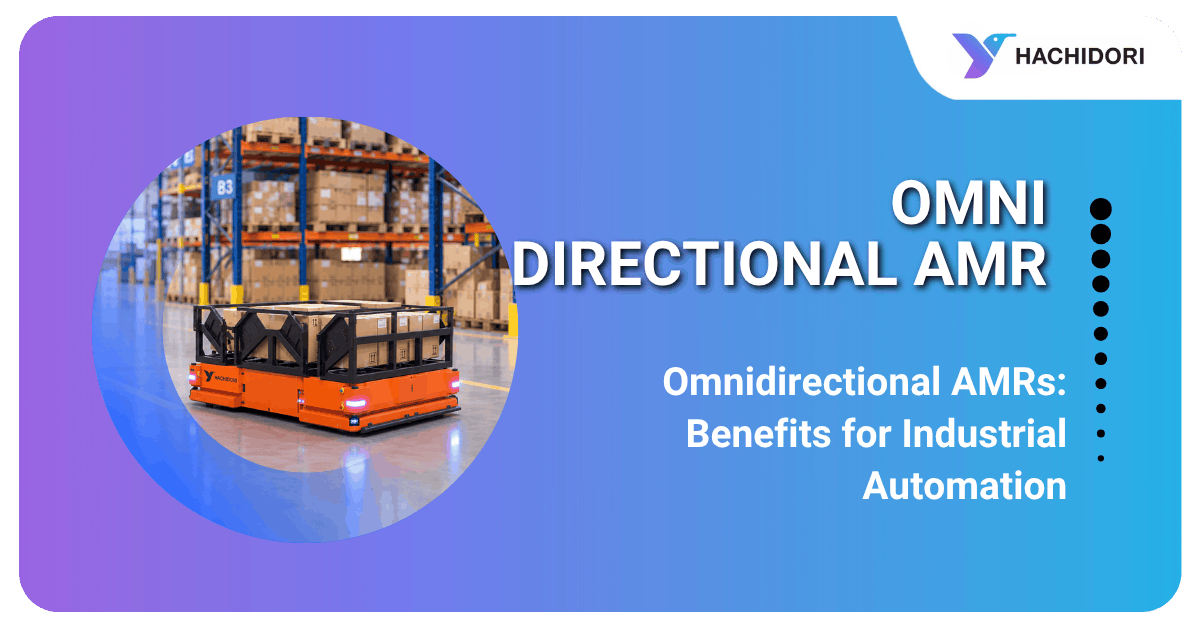
Moving heavy materials through narrow factory aisles, busy production floors, and congested warehouse spaces can create bottlenecks for industrial operations. Conventional forklifts and material handling equipment often need additional turning space, while manual transportation can divert employees from higher-value production activities.
An omnidirectional material handling robot offers an alternative by moving forward, backward, sideways, and diagonally, with the ability to rotate in place. These capabilities help manufacturers automate heavy-load transportation in facilities where space utilization, material flow, and operational flexibility matter.
For industrial procurement managers, the key question is not simply whether an autonomous mobile robot (AMR) can move a load. It is whether the robot can improve material flow, integrate with existing processes, meet safety requirements, and deliver a justifiable return on investment.
What Is an Omnidirectional Mobile Robot?
An omnidirectional autonomous mobile robot is a self-navigating industrial robot designed to move loads in multiple directions without requiring a conventional turning arc. Depending on its drive system, it can travel sideways, move diagonally, and rotate within a small footprint.
Unlike conventional material handling vehicles that must maneuver into position before turning, an omnidirectional AMR can align itself with racks, workstations, and load transfer points in confined areas.
For example, a robot transporting a heavy metal rack through a narrow manufacturing aisle may be able to approach a workstation sideways rather than make a wide turn. This can simplify docking and help make better use of available floor space.
Hachidori Robotics’ Omni Direction ULC AMR is designed for heavy-duty unit-load transportation, with configurations supporting payloads of 2, 3, and 4 tons.
6 Benefits of Omnidirectional AMRs for Industrial Automation
1. Better Space Utilization in Narrow Aisles
Factory floor space is expensive, and expanding an existing facility may not be practical. Conventional forklifts and some mobile robots require room to turn, which can limit aisle layouts and complicate material transfers.
An omnidirectional AMR can move laterally and rotate in place, helping it maneuver through constrained areas and align with pickup and delivery points.
Where it helps:
- Manufacturing facilities with narrow material movement corridors.
- Warehouses handling large pallets and bulky unit loads.
- Engineering plants with irregular workstation layouts.
- Production areas where heavy loads need precise positioning.
The actual space savings depend on the robot’s dimensions, load size, safety clearances, and the facility layout. A site assessment is necessary before reducing aisle widths or changing traffic routes.
2. More Flexible Heavy-Load Transportation
Moving heavy materials requires equipment suited to the load’s weight, dimensions, stability, and center of gravity. An omnidirectional AMR designed for heavy payloads can automate repetitive transportation between storage areas, production stations, and assembly zones.
Hachidori Robotics offers the Omni Direction ULC AMR in 2-ton, 3-ton, and 4-ton configurations. The product is designed for applications involving palletized goods, metal racks, steel coils and rolls, and bulk containers, subject to the specific configuration and load requirements.
For example, an automotive supplier could evaluate a heavy-duty AMR for transporting component racks between a storage area and assembly stations. The robot’s sideways movement can help with positioning at transfer points where turning space is limited.
Before selecting a model, procurement teams should verify payload capacity under actual operating conditions, including the load carrier, attachment, load distribution, and docking requirements.
3. Improved Material Flow and Production Continuity
Production lines depend on materials reaching the right workstation at the right time. Delayed component deliveries can interrupt assembly, while poorly coordinated movements can create queues around loading and unloading points.
An omnidirectional AMR can be incorporated into a scheduled material transportation workflow, moving loads between predefined pickup and delivery locations.
When integrated with warehouse management systems (WMS), enterprise resource planning (ERP) systems, or suitable fleet management software, these workflows can be coordinated with production requirements.
Potential applications include:
- Delivering components to assembly stations.
- Moving work-in-progress materials between production stages.
- Transporting finished goods to designated storage locations.
- Replenishing material at manufacturing workstations.
The benefit depends on task scheduling, loading and unloading times, traffic management, and the number of transport missions completed per shift. Robot speed alone does not determine overall throughput.
4. Reduced Dependence on Manual Transportation
Manual movement of heavy materials can consume significant employee time, particularly when the same routes are repeated across multiple shifts.
Automating suitable transportation tasks can allow employees to focus on activities such as inspection, assembly, machine operation, and quality control.
However, an AMR does not eliminate every manual task. Workers may still be required to load and unload materials, supervise exceptions, maintain the equipment, and manage workflows.
For procurement managers, the better approach is to measure the current labor hours spent on transportation and compare them with the staffing, supervision, and maintenance requirements of the proposed automated system.
This provides a more realistic view of potential operating-cost improvements than assuming every automated transport mission eliminates a worker’s role.
5. Greater Flexibility Than Fixed-Route Material Handling
Traditional automated guided vehicles (AGVs) often use predefined guidance infrastructure or routes, depending on the system. Autonomous mobile robots can use onboard navigation and sensing to determine their movements and respond to obstacles.
Hachidori Robotics uses its patented Wireless Natural Navigation (WiNN) technology with sensor fusion. Its Omni Direction ULC AMR product page describes 2D LiDAR and 3D depth-camera sensing, dynamic routing, and integration capabilities for industrial material movement.
This combination can be useful in facilities where production layouts, storage locations, and traffic conditions change over time.
For example, when a workstation is relocated, an AMR-based workflow may be easier to adapt than a system dependent on permanently installed guidance paths. The actual change required depends on the navigation system, facility mapping, traffic rules, and integration design.
6. Better Visibility Into Material Movement
Industrial procurement teams need more than automated transportation. They also need visibility into whether the system is completing tasks as expected.
A connected AMR fleet can provide information such as task status, robot availability, completed missions, charging requirements, and operational exceptions, depending on the software and configuration.
This information helps plant teams investigate recurring delays, identify underused equipment, and understand where material flow is being interrupted.
To make this data useful, establish baseline and post-deployment measurements for mission completion, waiting time, delivery accuracy, robot utilization, and unplanned downtime.
Where Can Omnidirectional Material Handling Robots Be Used?
Omnidirectional AMRs are particularly relevant when heavy loads must move through confined or irregular industrial environments.
| Industry | Potential application |
|---|---|
| Automotive manufacturing | Moving component racks, tooling, and assembly materials |
| Heavy engineering | Transporting metal parts and heavy industrial loads |
| Metal fabrication | Moving suitable steel coils, rolls, and material carriers |
| Warehousing | Transferring heavy unit loads between storage and dispatch zones |
| Electronics manufacturing | Positioning production materials and equipment where load and floor requirements permit |
| General manufacturing | Delivering work-in-progress materials between workstations |
The suitability of each application depends on payload, load dimensions, floor conditions, route geometry, docking arrangements, and operational safety requirements.
Omnidirectional AMR vs. Conventional Material Handling Equipment
The right choice depends on the transportation task rather than the technology alone.
| Evaluation factor | Omnidirectional AMR | Conventional forklift | Fixed-route AGV |
|---|---|---|---|
| Movement | Forward, lateral, diagonal, and in-place rotation, depending on design | Steering and turning maneuver | Depends on drive system and guidance design |
| Route flexibility | Can support dynamic routing with suitable navigation | Operator-controlled | Often follows predefined routes |
| Heavy-load capability | Model-specific; Hachidori’s range supports 2–4 tons | Available in a wide range of capacities | Depends on the selected vehicle |
| Human involvement | Reduced for automated transport tasks | Requires an operator for driving | Automated during supported missions |
| Layout changes | May be adaptable through mapping and configuration | Flexible but operator-dependent | Route or guidance changes may be required |
| Best-fit consideration | Heavy loads, constrained spaces, and repetitive automated transport | Flexible manual handling and varied tasks | Repetitive, predictable transport routes |
This comparison is indicative rather than universal. Specific forklift, AGV, and AMR models can have different capabilities, safety features, and integration requirements.
How to Choose the Right Omnidirectional AMR
Before purchasing an omnidirectional AMR, procurement managers should evaluate the following factors.
1. Payload and load stability: Confirm the maximum load, dimensions, center of gravity, load carrier, and attachment requirements.
2. Aisle and docking geometry: Measure the narrowest operating passages, turning and alignment areas, workstation interfaces, and required safety clearances.
3. Navigation and obstacle detection: Ask how the robot identifies obstacles, handles blocked routes, detects people, and responds to sensor or communication failures.
4. Integration requirements: Check compatibility with existing WMS, ERP, production systems, automated doors, conveyors, and other equipment.
5. Battery and operating shifts: Evaluate charging time, battery-swapping arrangements, mission duration, and expected availability across shifts.
6. Safety and commissioning: Review the manufacturer’s risk assessment, emergency-stop functions, operating modes, maintenance procedures, and applicable standards. ISO 3691-4 is an important reference for safety requirements covering driverless industrial trucks and their systems. Verify the applicable published edition and the specific system’s conformity documentation before procurement.
7. Total cost of owne